
Introduction
A reader searches for about droven.io and finds five different stories. One calls it an AI platform with tools to try. Another calls it a free blog with no product at all. A third result sits on drovenio.com, a lookalike domain that is not droven.io. A fourth claims a named founder the official site never mentions. Only one story can match the real site. The official site settles most of the question. It shows a stream of articles, no product, no pricing, and no About page. This article explains what droven.io is, what it covers, who runs it, what is still unconfirmed, and how to judge any article on it in five minutes.
What Is Droven.io?
Droven.io is a free editorial tech blog. It publishes articles about artificial intelligence, machine learning, cloud computing, cybersecurity, and digital transformation, in plain language for readers who are not specialists. Its homepage calls itself a trusted source of AI info and an editorial hub. Its headline reads “Pioneering AI, Tech and Digital Transformation Insights”.
In plain terms, droven.io is reading material. A reader opens it, reads an explainer or a guide, and leaves. There is no account to create, no dashboard to log into, no tool to try, and no price to pay. The site runs on WordPress and shows its newest articles first.
Readers who want the full picture should read the TechnologySaaS guide to Droven.io, which covers the site in detail, and the guide to what is droven.io, which answers the basic question. Readers who typed the name with a space should read the guide to droven .io, which explains the spaced search form and how to reach the real site. Readers who want the cloud coverage in depth should read the droven.io cloud computing guide, which explains the cloud explainers in detail.
What Droven.io Is and Is Not
The table below gives the short version. It is the fastest way to clear up the confusion around the site.
| Claim | True or false |
|---|---|
| A free editorial tech blog | True, it publishes articles and nothing else |
| An AI platform with tools to try | False, there is no tool, no demo, and no login |
| A cloud provider | False, it explains cloud, it does not sell it |
| A software product | False, there is no software to download or buy |
| A shop | False, there is no store and no price list |
| A news site with named reporters | False, most articles carry a generic staff byline |
| Free to read | True, no paywall and no subscription seen |
The confusion is easy to understand. Third-party guides describe droven.io as a platform, and the word platform sounds like a product. The official site shows no product at all. A reader who trusts the third-party description will look for a tool that does not exist. A reader who opens the real site will see a blog.
Droven.io at a Glance
The table below gives the snapshot as seen in November 2026. Every item comes from the site’s own pages or from independent write-ups that checked those pages. Where a fact is only reported and not confirmed on the official site, the table says so.
| Item | Detail |
|---|---|
| What it is | Free editorial tech blog, not software |
| Tagline | Trusted AI info, latest tools, guides, and future technology insights |
| Headline | Pioneering AI, Tech and Digital Transformation Insights |
| Platform | WordPress editorial blog, no login and no dashboard |
| Categories | 95, as reported by independent write-ups that checked the sitemap |
| Posts | Well over 1,500, as reported by independent write-ups that checked the sitemap |
| Earliest pages | September 2025, as reported, from the terms and privacy page dates |
| Site stamp | March 2026, as shown on the site itself |
| Sitemaps last updated | 6 November 2026, as reported |
| Most articles byline | “adminde”, a generic staff byline, as reported |
| Contact | admin@droven.io, plus a contact page at droven.io/contact-us |
| Guest posts | Via a seolinkers.com email address, as reported |
| Named owner | None, no owner is named anywhere on the site |
| Headquarters | Not stated anywhere on the site |
| Cost | Free to read, no paywall and no subscription seen |
| About page | None, the page sitemap lists just 5 pages and none is an About page, as reported |
Two dates need care. The site itself shows a March 2026 stamp, while independent write-ups report September 2025 dates on the terms and privacy pages. Both dates are reported here as found, and neither one proves a founding date. A reader should treat the site as young either way, and young sites earn trust article by article rather than by reputation.
What Topics Does Droven.io Cover?
The site covers five core tech topics. Artificial intelligence and generative AI sit at the centre, with explainers on tools, trends, and how teams use AI at work. Machine learning covers models, training, and practical uses. Cybersecurity covers threats, safety basics, and ideas such as zero trust architecture, which assumes no user or device is trusted by default. Cloud computing covers service models, providers, and migration in plain words. DevOps and careers cover workflows, tools, and working in tech.
The site also covers topics outside technology. Independent write-ups report non-tech categories such as real estate, pet care, and CBD among its 95 categories. That mix matters. A reader who trusts the AI coverage should not assume the same care went into a pet care article. Each topic area has to be judged on its own.
The core tech coverage is the reason to visit. The non-tech categories are a reason to read carefully. A site that publishes across 95 categories cannot have a specialist for every one of them, so the reader is the final editor.
Who Is Droven.io For?
Droven.io fits four kinds of reader. A beginner who wants a plain-language explanation of a tech topic will find the explainers easy to follow. A student or job seeker who wants a quick grounding in AI, cloud, or cybersecurity will find short guides that start from zero. A small business owner who wants to understand a technology before buying it will find the plain-language comparisons useful. A curious reader who wants to keep up with AI trends will find a steady stream of new articles.
It is not for a reader who needs a verified fact for a decision that costs money. It is not for a researcher who needs a named author, a cited source, and a date on every claim. It is not for a buyer who wants a product demo, a price, or a support team. Those readers should use the site as a starting point and confirm the key facts elsewhere.
Readers who want the strategy side of AI can read the TechnologySaaS article on AI transformation as a problem of governance. It covers the planning and control side that tool guides often assume. The Deep AI guide shows a useful contrast: Deep AI is a tool a reader can open and use, while droven.io is a publication a reader can open and read.
Who Runs Droven.io?
This is the honest answer: nobody knows from the public site. No owner is named anywhere on the site. No founder is named. No editorial team is listed. No headquarters is stated. No funding is disclosed. No founding date is given. These facts are unconfirmed, not hidden in a footnote, and this article does not invent them.
What is known is small. Most articles carry the staff byline “adminde”, as reported by independent write-ups that checked the site. The contact address is admin@droven.io. Guest post enquiries go to a seolinkers.com email address, as reported, which suggests the site works with an outside outreach or SEO partner. The site runs on WordPress. That is the whole public record.
A named owner matters for trust. A reader can check a named person, a named company, and a named address. Without any of those, the only thing to judge is the writing itself. That is why the five-minute check later in this article matters more than usual. On a site with no named owner, each article has to earn its own trust.
The Missing About Page
The strangest fact about droven.io is also the most useful one for a reader. The site has no About page. Independent write-ups that checked the site report that its page sitemap lists just 5 pages, and none of them is an About page. The site tells readers what it covers, but it never says who it is.
Most blogs have an About page. It names the owner, states the mission, and gives a contact. Its absence is not proof of anything bad. Small editorial sites often skip it. But its absence is a fact a reader should know, because it changes how the site should be used. A reader cannot learn who runs droven.io from droven.io itself. The only way to learn anything about the site is to read its articles and check them.
This article exists because the site has no About page. It answers the questions an About page would normally answer, from the public record and from independent write-ups, and it labels every fact that is only reported and not confirmed on the official site.
Droven.io vs Drovenio.com: the Lookalike Warning
Drovenio.com is not droven.io. It is a different site on a lookalike domain, and readers can land on the wrong one. The two names differ by one letter, and search results can mix them up.
Drovenio.com has its own About page. That page claims values such as clarity, honesty, and usefulness, and it lists wider topics such as robotic process automation, gadgets, careers, and jobs. Those claims belong to drovenio.com, not to droven.io, and this article does not present them as droven.io’s own. A reader who reads the drovenio.com About page and thinks it describes droven.io has read the wrong site.
The fix is simple and takes seconds. Check the address bar before trusting a page. The real site shows droven.io and nothing more. If the address bar shows drovenio.com, the page belongs to a different site. A reader who is unsure can also check the domain with ICANN Lookup, which shows who registered a domain and when.
How to Use Droven.io Well
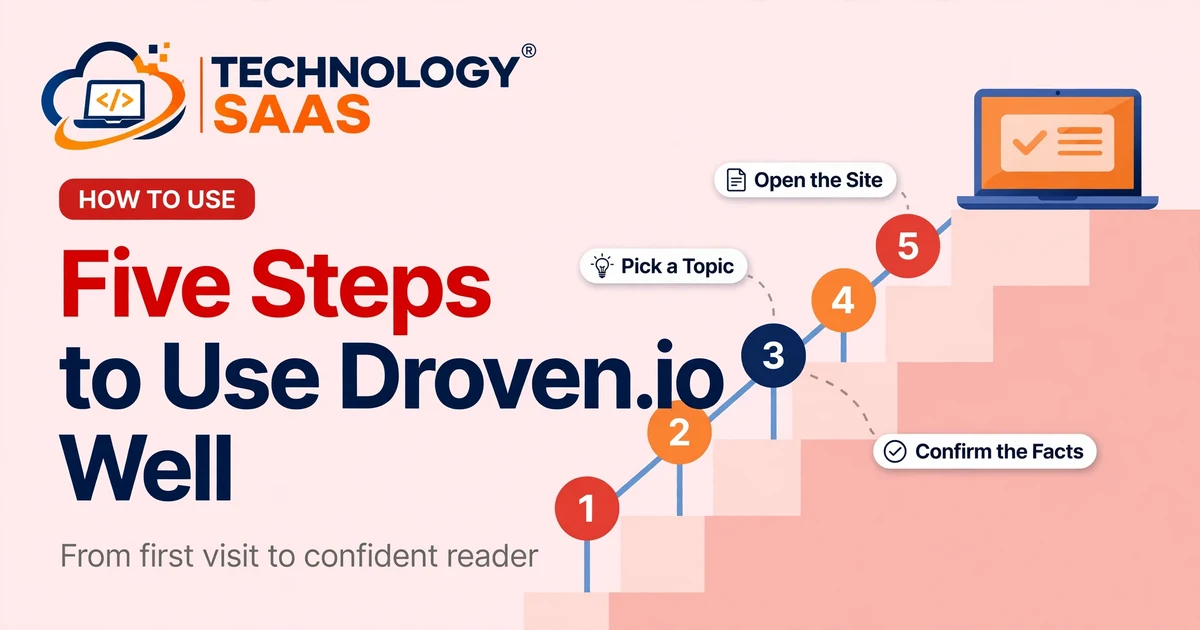
Using the site well takes five simple steps, and none of them needs an account.
First, reach the real site. Type droven.io into the address bar with no space, and check the address bar after the page loads. The real site shows droven.io, nothing more. Do not stop at drovenio.com, which is a different site.
Second, start with the topic, not the homepage. Pick one topic, such as AI or cloud computing, and read two or three articles in that topic before judging the site. One article tells a reader little. Three articles in one topic show whether the coverage is consistent.
Third, check the date on each article. Technology changes fast, so a guide from March 2026 may describe a service that has changed since. The date sits near the top of each article. Microsoft Learn offers free training paths that state their own dates, and comparing the two is a good habit.
Fourth, follow the site’s own links outward. A good article points to a source a reader can check. A claim about a named product should link to the product page. A claim about a security idea should link to a reference such as Wikipedia. An article with no outward links is asking for trust it has not earned.
Fifth, confirm any decision elsewhere. The site explains options, but it does not sell anything, so prices, limits, and facts live on the vendor page or the official docs. A reader should never act on a price or a claim quoted in a guide without checking it at the source.

How to Judge a Droven.io Article in 5 Minutes
Five checks, one minute each, are enough to judge any article on the site.
The first check is the address bar. Only the real domain is the real site, so confirm the address bar shows droven.io. The lookalike drovenio.com runs its own guides, so a reader who lands there is reading a different site.
The second check is the date. A guide without a visible date may describe a service that no longer works the same way. Always check the date before trusting a claim. Google Search Central explains how Google discovers new pages, which is a useful reminder that search results can lag behind the live site.
The third check is the byline. Most droven.io articles carry the generic staff byline “adminde”, as reported. A generic byline is common for small editorial sites, but it means the reader cannot check the author. Weigh the claims against other sources rather than taking one article as final.
The fourth check is the outward link. A good article links to the source of its key claim. Click one link. If it goes to a real source that supports the claim, the article has earned some trust. If the article has no outward links at all, treat its claims as unconfirmed.
The fifth check is the claim itself. Pick the strongest claim in the article and search for it on a second source. If a second source agrees, the claim is probably sound. If no second source agrees, or if the claim names a person, a price, or a number the official site never states, do not trust it.
A worked example makes this concrete. Suppose an article claims a named founder launched droven.io in a named year. The five-minute check fails fast: the official site names no founder and gives no founding date, and no About page exists to confirm it. The claim is unconfirmed, and a careful reader would not repeat it.
What Droven.io Does Not Offer
The site does not offer a product, a tool, or a service. It does not offer a demo, a free trial, or a pricing page. It does not offer an account, a login, or a dashboard. It does not offer support, consulting, or a contact form for buying help. It does not offer a named author to contact, a named owner to hold to account, or a headquarters to write to.
It also does not offer a guarantee. Articles are free to read, and free reading carries no promise that a claim is correct. A reader who needs a guarantee should pay for a source that offers one, such as a vendor doc or a named expert.
Knowing what the site does not offer is as useful as knowing what it does. A reader who expects a tool will be disappointed. A reader who expects plain-language reading will get exactly that.
Should You Cite Droven.io?
A reader who wants to cite droven.io in their own work should run through this checklist first.
Cite it when the article is a plain-language explanation of a standard idea, when the date is visible and recent, when the article links outward to a source that supports the claim, and when a second source agrees with the claim. In that case, cite droven.io as a secondary source and link to the primary source too.
Do not cite it as the only source for a fact that costs money, a fact about a named person, a fact about a price, or a fact about the site itself, such as its owner or its founding date. For facts about the site, say plainly that the site does not state them. For facts that matter, cite the vendor page, the official docs, or a named expert instead.
A team deciding on an AI workflow gives a useful example. A manager reads a droven.io guide on AI tools, then checks the tool’s own page for the price and the limits, then asks the team to try the tool for a week. The droven.io article started the decision. It did not finish it. That is the right role for the site: a starting point, not a final authority.
Frequently Asked Questions
What is droven.io?
It is a free editorial tech blog that publishes plain-language articles about artificial intelligence, machine learning, cloud computing, cybersecurity, and digital transformation. It is a publication to read, not a product to buy.
Who owns droven.io?
Nobody knows from the public site. No owner is named anywhere on droven.io, and no founder, headquarters, or funding is disclosed. This is unconfirmed, not a secret this article can reveal.
Why does droven.io have no About page?
Independent write-ups that checked the site report that its page sitemap lists just 5 pages, and none of them is an About page. The site has never published one, as far as the public record shows. This article answers the questions an About page would normally answer, from the public record.
Is droven.io free?
Yes. The site is free to read, with no paywall and no subscription. There is no paid tier, so a reader should never pay for access.
What is the difference between droven.io and drovenio.com?
Droven.io is the editorial site this guide describes. Drovenio.com is a different, lookalike domain with its own About page and its own claims. Always check the address bar before trusting a page.
Is droven.io a reliable source?
It is a useful starting point for plain-language explanations, and its core tech coverage is a reasonable first read. It is not a final authority. It has no named owner, no named authors, and no About page, so a reader should check the date, follow the outward links, and confirm important claims on a second source.
How do I open droven.io?
Type droven.io into the browser address bar with no space, then check the address bar to confirm the site. Or search for “about droven.io” on Google and click the result that shows droven.io as the domain.
Can I write a guest post for droven.io?
Guest post enquiries go to a seolinkers.com email address, as reported by independent write-ups. The site itself does not publish guest post terms on a public page, so a writer should confirm the arrangement by email before sending any work.
Conclusion
About droven.io has a short answer. It is a free editorial tech blog that explains technology in plain language. It covers AI, machine learning, cloud computing, cybersecurity, and more. It costs nothing, needs no account, and sells no product.
The confusion around it comes from third-party guides that describe a platform the official site does not show, from a lookalike domain that runs its own About page, and from the site’s own silence about who runs it. The fix is simple: open droven.io, check the address bar, read the explainers, check their dates, follow the outward links, and confirm any important claim on a second source. Used that way, droven.io is a useful first stop for understanding a new technology, and a good place to return to when a new tool or trend needs a plain explanation.