
Introduction
A company buys AI tools, runs a pilot, and sees a good demo. Then nothing scales. Legal asks who approved the data. Security asks who can see the outputs. A manager asks who is responsible when the model is wrong. Nobody has a clear answer, so the pilot stays a pilot. This article solves that problem. It explains why AI transformation is a problem of governance rather than a problem of technology, names the five gaps behind most failures, and sets out a short plan any team can follow to give every AI system an owner, a risk tier, and an evidence trail.
What the Phrase Means
AI transformation means changing how a company works with AI: new tools, new workflows, and new decisions made with machine help. Governance means the rules and people around those changes: who approves a system, who owns it, what data it may touch, and who answers when it goes wrong.
The phrase AI transformation is a problem of governance says the hard part of that change is not the model. Modern models are capable enough for most business work. The hard part is the set of decisions around them, and most companies have not made those decisions yet.
When leaders say “AI transformation is a problem of governance”, they mean the bottleneck moved. Ten years ago the question was whether the technology worked. Today the question is whether the organisation can use it safely, fairly, and accountably at scale. That is a governance question, not a model question.
Think of it like a company car fleet. The cars work. The problem is who may drive them, where they may go, who pays for damage, and what happens after an accident. A company that buys cars without answering those questions does not have a transport problem. It has a governance problem. AI is the same: AI transformation is a problem of governance, not a problem of models.
In the research literature, AI governance is defined by questions of accountability: who is accountable for AI systems, what is governed, when in the lifecycle governance happens, and how it is enforced, as summarised on Wikipedia’s AI governance page.
What the Evidence Shows
The research firms that track enterprise AI keep reaching the same conclusion from different directions. Adoption is high. Results are low. The gap between the two is governance, not capability.
| Finding | Reported by | What it means |
|---|---|---|
| About 95% of enterprise generative AI pilots delivered no measurable profit impact | MIT, The GenAI Divide, 2025 | The cause was organisational, not technical |
| 72% of organisations had adopted AI in at least one function, yet fewer than 1 in 5 had a formal AI governance framework | McKinsey Global Institute, 2024 | Adoption ran ahead of accountability |
| Nearly 70% of AI transformation challenges come from people and process issues | Boston Consulting Group | Technology is the smaller share of the problem |
| 74% of leaders plan to deploy agentic AI within two years, only about 21% report mature governance for it | Deloitte, State of AI in the Enterprise, 2026 | Agents are coming faster than the controls for them |
| By 2027, 40% of enterprises will demote or decommission autonomous AI agents because of governance gaps found after a production incident | Gartner | Ungoverned agents get switched off |
MIT’s GenAI Divide study from 2025 reviewed hundreds of enterprise deployments and found about 95 percent of generative AI pilots delivered no measurable profit impact. The cause was organisational, not technical: pilots were built without a path to production, without an owner, and without redesigned workflows.
McKinsey’s 2024 survey found 72 percent of organisations had adopted AI in at least one business function, while fewer than one in five had a formal AI governance framework. That is the gap in one sentence: capability without accountability.
The Boston Consulting Group reports that nearly 70 percent of AI transformation challenges come from people and process issues rather than technology limits. Deloitte’s 2026 State of AI in the Enterprise report found 74 percent of leaders plan to deploy agentic AI within two years, while only about 21 percent report mature governance for autonomous agents. Gartner predicts that by 2027, 40 percent of enterprises will demote or decommission autonomous AI agents because of governance gaps discovered only after a production incident.
None of these studies says the models are too weak. All of them say the organisations around the models are not ready. That is the point of the phrase: AI transformation is a problem of governance, and the numbers back it.
The Five Governance Gaps That Stall AI Transformation
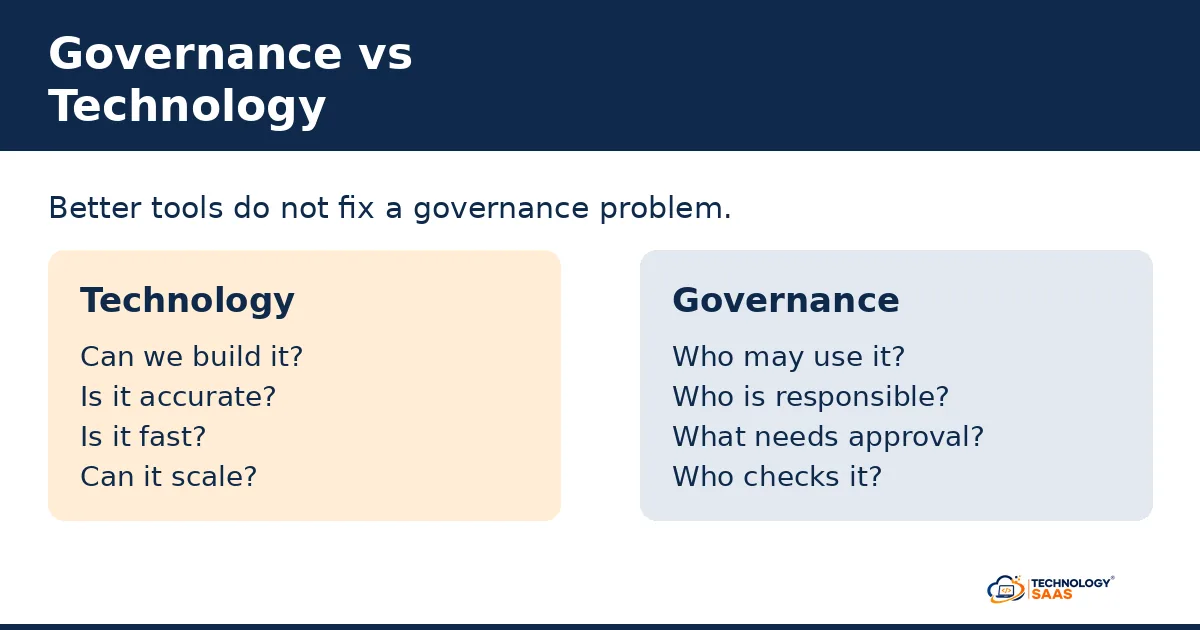
Most failures trace back to five gaps, and each one shows why AI transformation is a problem of governance. A company can have strong engineers and still stall on all five, because none of them is an engineering problem.
1. No owner. An AI system with no named owner has no one to approve changes, answer questions, or accept responsibility. When it breaks, everyone points somewhere else. Every system needs one person whose name is on it.
2. Ungoverned data and access. A model is only as safe as the data it can reach. If any employee can connect any tool to customer records, contracts, or source code, the risk is not theoretical. Access must be limited to what each job needs, and someone must review it.
3. Policy on paper, not at runtime. Many companies have an AI policy that nobody can find and nothing enforces. A policy that lives in a document while the tools run without limits is decoration. Rules must be enforced where the system runs: blocked actions, approval steps, and audit logs.
4. No measurement or evidence trail. If a company cannot show what its AI did, on which data, and with whose approval, it cannot defend a decision, fix a mistake, or pass an audit. Logging is not bureaucracy. It is the record that makes accountability possible.
5. No plan for agents and incidents. Autonomous agents act without a human in the loop, so they need limits set in advance: what they may do alone, what needs approval, and how to stop them. Most companies also lack an incident plan for AI, so the first bad output becomes a crisis meeting instead of a routine fix.
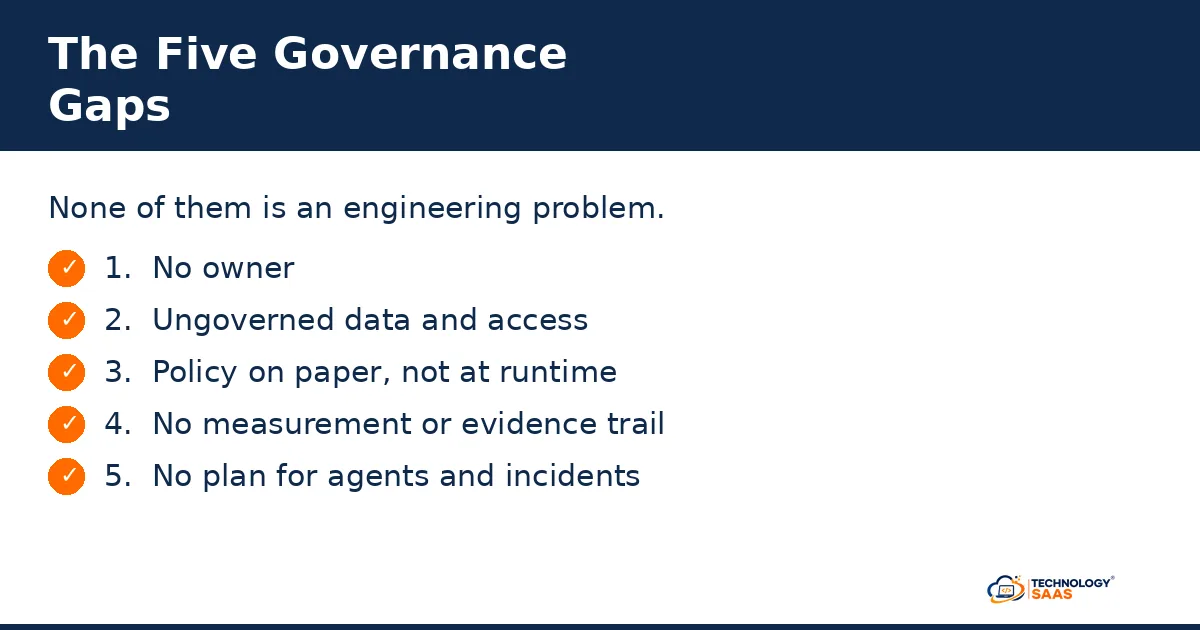
Governance vs Technology: What Each Side Answers
| Question | The technology answer | The governance answer |
|---|---|---|
| Can we build it? | Yes, models and tools exist | Who may use it, on what data, for which decisions |
| Is it accurate? | Benchmarks and evaluations | Who checks it in production, and how often |
| Is it fast? | Latency and cost | What it may do without a human in the loop |
| Did it fail? | Logs and traces | Who is accountable, and what the fix is |
| Can it scale? | More compute and more users | Whether every deployment has an owner and a risk tier |
The table shows why buying better tools does not fix a governance problem. It shows in one view that AI transformation is a problem of governance, not a problem of technology. A faster model still needs an owner, a limit, and a log. Technology answers “can we do it”. Governance answers “should we, who decides, and who is responsible”. Both matter, but only one of them is usually missing.
The Three Frameworks That Define the Field
Three reference points now define AI governance. They are the practical answer to the claim that AI transformation is a problem of governance, and they fit together rather than compete.
NIST AI Risk Management Framework. The NIST AI Risk Management Framework (AI RMF 1.0, released January 2023) is a voluntary framework that organises the work into four functions: Govern, Map, Measure, and Manage. It is free, practical, and the best starting point for most companies. NIST also published a Generative AI Profile in July 2024 for the risks specific to generative systems.
EU AI Act. The EU AI Act (Regulation (EU) 2024/1689) is the first comprehensive AI law worldwide. It entered into force on 1 August 2024 and sorts AI systems into four risk levels, from unacceptable risk (banned) to minimal risk (largely unregulated). High risk systems face strict duties on risk assessment, data quality, logging, documentation, and human oversight. It applies to many companies outside the EU too, because it covers systems that affect people in the EU.
ISO/IEC 42001. ISO/IEC 42001:2023 is the world’s first AI management system standard. It sets out how to establish, run, and improve an AI management system using the Plan-Do-Check-Act cycle. It suits organisations that want a certifiable, auditable system rather than a one off project.
| Framework | What it is | Who it suits |
|---|---|---|
| NIST AI Risk Management Framework | Voluntary framework: Govern, Map, Measure, Manage | Any organisation starting structured AI risk management |
| EU AI Act | First comprehensive AI law, risk based, four risk levels | Organisations operating in the EU or serving EU users |
| ISO/IEC 42001:2023 | World’s first AI management system standard | Organisations that want a certifiable management system |
A small company can start with the NIST framework alone. A company serving EU customers must also track the AI Act. A company that needs to prove its governance to clients or regulators can certify against ISO/IEC 42001. The frameworks agree on the basics: name an owner, assess risk, control data, keep records, and keep a human in charge of high risk decisions.
What Good Governance Looks Like in Practice
Good governance is boring in the best way, and it is the direct answer to the claim that AI transformation is a problem of governance. It is a short list of habits, repeated for every system.
First, keep an inventory. List every AI system in use, including free tools employees adopted on their own. A system nobody knows about cannot be governed.
Second, assign one owner and one risk tier per system. The owner approves changes. The tier decides how much review the system gets. Low risk tools get light review. High risk tools, such as hiring or credit decisions, get human oversight and testing.
Third, control data and actions. A system should reach only the data its job needs. An agent should take low risk actions alone and ask a human before high risk ones, such as sending money, changing records, or contacting customers.
Fourth, log everything that matters. Inputs, outputs, approvals, and overrides should be recorded so any decision can be traced.
Fifth, review on a schedule. Test the system on real tasks, check for bias and errors, and retire tools that have no owner or no measured result. A pilot that never gets measured should not become permanent.
None of this needs a large team. It needs a written list, a named owner, and a monthly review. That is the whole operating model. It is also the practical answer to the claim that AI transformation is a problem of governance, and it is what separates companies whose AI scales from companies whose pilots stall. For a small team, this discipline matters as much as the growth plan itself, as covered in the guide to growing a startup without venture capital. TechnologySaaS offers AI and SEO services for teams that want help putting this in place.
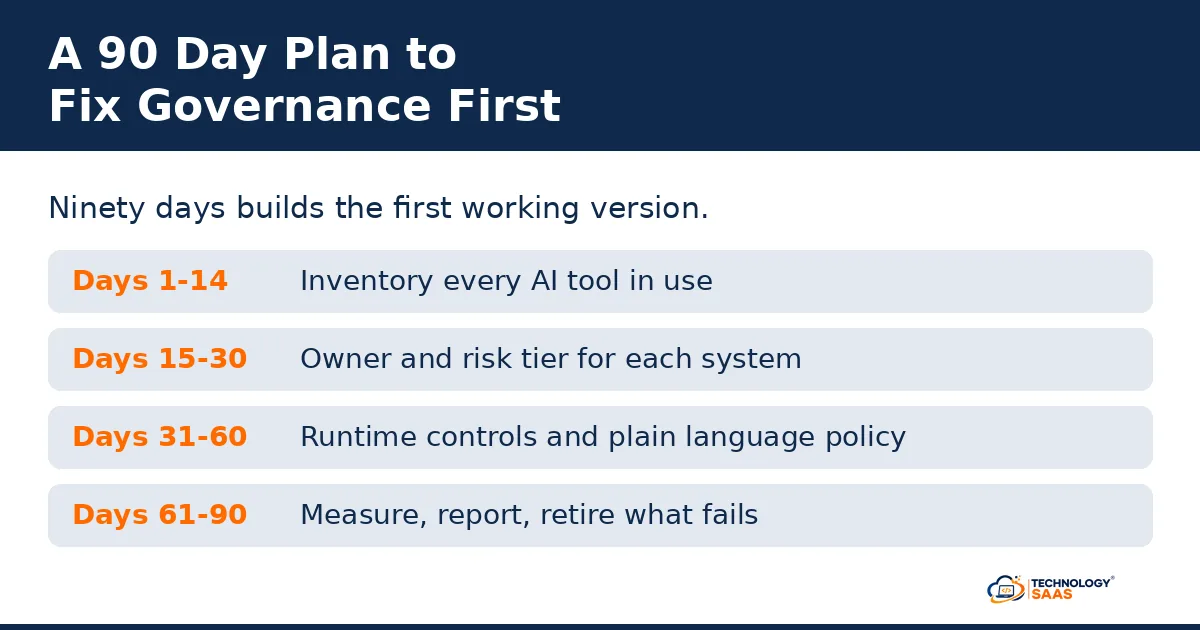
A 90 Day Plan to Fix Governance First
Days 1 to 14: inventory. Find every AI tool in use, including free and employee chosen tools. Record what each one does, what data it touches, and who uses it.
Days 15 to 30: ownership and risk tiers. Give every system a named owner and a risk tier. Any system with no owner gets paused until one is named.
Days 31 to 60: runtime controls. Set data access limits, add human approval for high risk actions, and switch on logging for high risk systems. Rewrite the AI policy in plain language and make it easy to find.
Days 61 to 90: measure and report. Review the first incidents and near misses, test high risk systems on real tasks, publish a short internal report, and retire pilots that have no owner or no measured result.
Ninety days does not finish governance. It builds the first working version, and that version removes the most common reasons pilots stall. That is what it looks like when a company accepts that AI transformation is a problem of governance.
A Short Checklist for Leaders
- List every AI tool in use, including free and employee chosen tools.
- Name one owner for each system.
- Give each system a risk tier and a review date.
- Limit data access to what the job needs.
- Require human approval before high risk actions.
- Log inputs, outputs, and decisions for high risk systems.
- Test each system on real tasks before wider rollout.
- Write the policy in plain language and make it easy to find.
- Review incidents monthly and update the rules.
- Retire pilots that have no owner or no measured result.
FAQs
Why is AI transformation a problem of governance and not technology?
Modern models are capable enough for most enterprise work. What stalls deployment is unclear ownership, policies that are not enforced at runtime, ungoverned data, and no evidence trail. Those are governance failures, not model failures. That is the plain meaning of the claim that AI transformation is a problem of governance.
What is AI governance in simple words?
It is the set of decisions and controls that say who may use AI, on what data, for which decisions, and who answers when something goes wrong.
Which framework should a small company start with?
The NIST AI Risk Management Framework, because it is free, voluntary, and organised around four simple functions: Govern, Map, Measure, and Manage.
Does the EU AI Act apply outside Europe?
It can. It covers providers and deployers whose AI systems affect people in the EU, so many non-EU companies fall within its scope.
How long does it take to fix AI governance?
A first working version takes about 90 days. Real maturity takes longer, but the first 90 days remove the most common failures.
What is the biggest governance mistake?
Letting pilots run with no owner, no risk tier, and no logging, then wondering why nothing scales.
Final Words
AI transformation is a problem of governance because the technology arrived before the decisions around it. The models work. The question now is whether companies can give each system an owner, a limit, and a record, and whether they can say who is responsible when it matters. Companies that answer those questions scale their AI. Companies that keep buying tools without answering them collect pilots. The fix is not another model. It is ninety days of governance, done in order.