
Introduction
Most founders face the same problem. They have a good product idea, but raising venture capital takes months, costs equity, and brings pressure to grow fast at any cost. Many good startups die in that race, not because the product was weak, but because the money ran out first. A startup booted approach solves this problem in a different way. Founders grow from customer revenue, keep their costs lean, and stay in control of their own company. This article shows how that works, step by step.
Readers will learn what a startup booted business is, why founders are choosing it in 2026, and the exact steps, money models and monthly numbers they need to grow a startup from revenue instead of from venture capital.
What Startup Booted Means
A startup booted business is a startup that grows from its own revenue instead of from venture capital. The founders pay for growth with money from customers, not with money from investors.
The idea is close to bootstrapping a business. In simple words, bootstrapping means starting and running a business without outside help or working capital. The founder survives on internal cash flow and stays very careful with spending.
A startup booted founder still takes money seriously. The difference is the source of that money. Instead of a funding round, the business earns its next month of growth from the last month of sales.
This is not the same as having no plan for money. Booted founders plan harder than funded founders, because every dollar they spend has to come from a customer first.
Why Founders Are Choosing It in 2026
Investors are more careful now than they were in 2020 to 2022. Funding rounds are slower, and investors ask for real revenue, real retention and a clear path to profit before they write a cheque.
At the same time, the cost of building a startup has fallen. AI tools now handle work that once needed a full team, from drafting code to answering support tickets and running outreach. A small team can serve more customers than before.
That combination has made the startup booted model popular with SaaS startups, AI native companies and lean digital businesses. Founders keep their ownership, avoid board pressure, and grow at a pace their revenue can support.
There is also a mindset change. Many founders no longer ask how fast they can raise money. They ask how fast they can build a healthy company with strong cash flow and steady growth.
Startup Booted vs Venture Capital
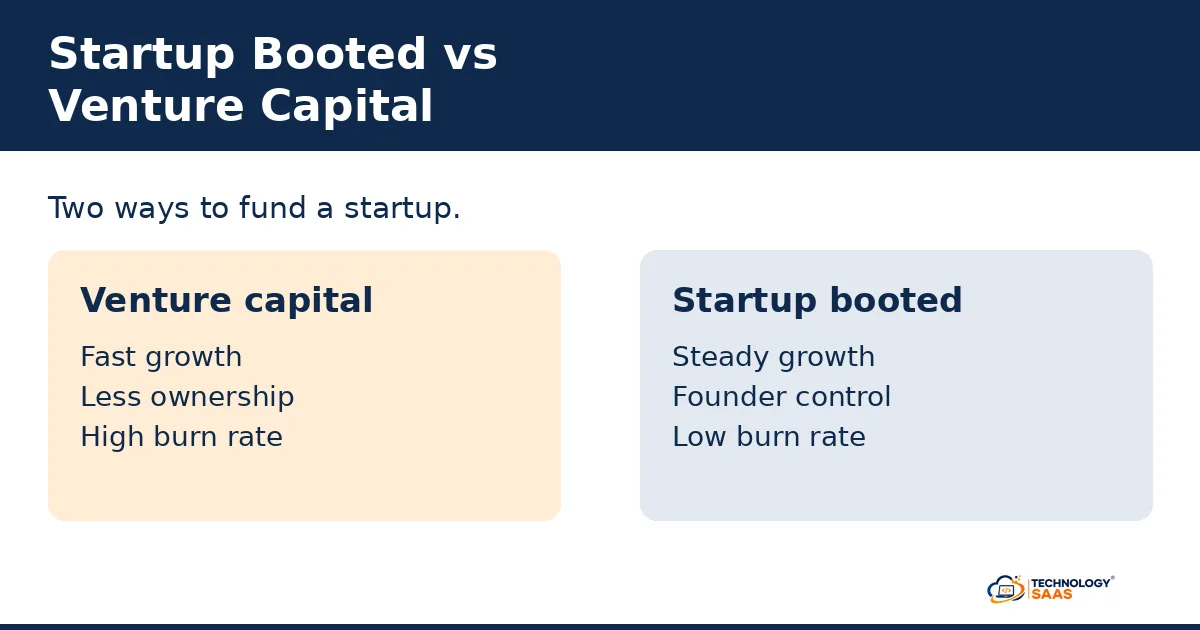
The two models solve different problems. Venture capital buys speed. A startup booted model buys control and survival. Neither one is right for every business, so founders should compare them honestly before choosing.
| Factor | Venture capital | Startup booted |
|---|---|---|
| Main fuel | Investor money | Customer revenue |
| Growth pace | Fast, often before profit | Steady, tied to revenue |
| Founder ownership | Falls with every round | Stays high |
| Control | Shared with investors and board | Stays with founders |
| Burn rate | Often high by design | Kept low on purpose |
| Pressure | Grow fast, raise again | Reach profit, stay alive |
| Best for | Winner take all markets | Niche, SaaS and service businesses |
Venture capital makes sense when a market rewards the fastest player and the business needs a lot of money before it can earn anything. A startup booted model makes sense when customers will pay early and the product can grow one paying user at a time.
Founders should also count the hidden cost of venture capital. Every round dilutes ownership. A founder who raises a pre seed, seed and Series A round can end up owning a small share of the company they started. Booted founders keep most of what they build.
7 Steps to Build a Startup Booted Business
Step 1: Solve one painful problem. Pick one clear problem and one clear buyer. A narrow problem is easier to sell than a broad idea. Talk to 10 to 20 potential buyers before writing any code. If they will not pay for a fix, the problem is not painful enough.
Step 2: Sell before you build. Offer the product before it is finished. A landing page, a short demo and a pre order link are enough to test demand. Real payments beat polite praise every time. If nobody pays, change the offer, not the logo.
Step 3: Launch a small paid version. Ship the smallest version that solves the problem and charge for it from day one. Free users give feedback, but paying users give truth. A small paid product also starts the revenue that funds step 4.
Step 4: Keep costs lean on purpose. Rent nothing you can share, hire nobody you can automate, and buy nothing that does not bring in revenue. Remote work, cloud tools and AI workflows keep a small team productive. Every saved dollar is a dollar of runway.
Step 5: Grow from revenue, not from rounds. Put profit back into the business in a fixed order. First, fix what paying customers complain about. Second, improve the channel that already brings customers. Third, test one new channel at a time. Do not open three new channels in the same month.
Step 6: Add non dilutive money only when it helps. Some money does not cost equity. Pre sales, annual plans paid upfront, grants, and revenue based financing all add cash without giving away shares. Use them for a clear purpose, like a product launch, not to cover a broken cost model.
Step 7: Decide the endgame early. A booted founder can choose to stay independent and profitable, sell the business later, or raise money later from a position of strength. That choice shapes every decision. A founder who wants to stay independent should not copy the hiring plan of a venture backed rival.
Money Models That Work Without Venture Capital
A startup booted business needs at least one money model that pays the bills before outside money arrives. Most successful booted startups mix two or three of these.
Subscription revenue is the most common model for SaaS startups. Monthly or annual payments give steady cash flow and make planning easier. Annual plans paid upfront also bring cash forward, which helps runway.
Pre sales work well for new products. Customers pay before launch in exchange for a discount or lifetime access. This tests demand and funds the build at the same time.
Services can fund a product. Many SaaS founders sell consulting, setup or training in the early months, then use that income to build the product. The service work also teaches them what customers really need.
Revenue based financing is a newer option. A lender gives cash in exchange for a share of monthly revenue until a fixed amount is repaid. It costs no equity, but founders should read the repayment terms carefully, because a bad month still means a payment is due.
Grants and partnerships are worth checking too. Some governments and large companies fund small businesses in specific fields. A distribution partnership can also bring customers without any ad spend.
For steady organic growth, many founders work with SEO professionals instead of buying expensive ads. Search traffic compounds over time, which suits a revenue first business. Store owners can also protect cart pages from search results so that Google shows their useful pages instead of empty cart pages.
Numbers to Watch Every Month
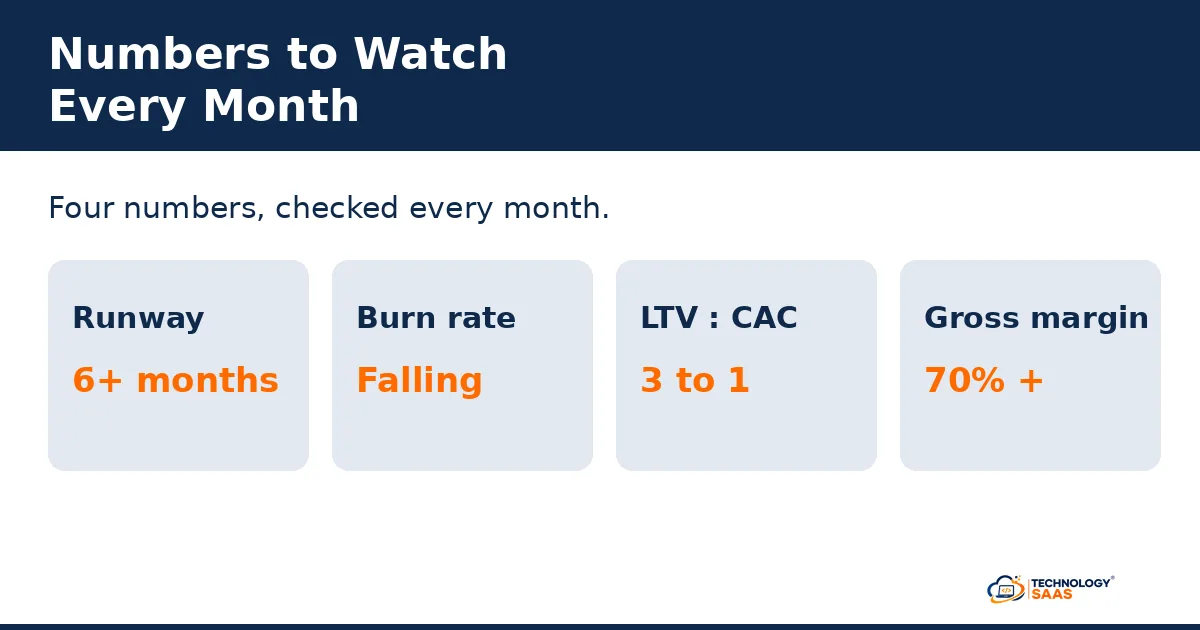
Booted founders live by their numbers. Four of them matter more than the rest, and all four fit on one page.
| Number | What it means | Healthy sign |
|---|---|---|
| Runway | Months of cash left at current burn | 6 months or more |
| Burn rate | Money spent minus money earned each month | Falling over time |
| LTV to CAC ratio | Lifetime value of a customer divided by cost to win them | 3 to 1 or better |
| Gross margin | Revenue left after direct costs | Above 70 percent for SaaS |
Runway is the most urgent number. A founder with 50,000 dollars in cash and a burn rate of 5,000 dollars a month has 10 months of runway. When runway falls below 6 months, the founder should cut costs or raise revenue before doing anything else.
Customer acquisition cost and lifetime value decide if growth is real. If it costs 50 dollars to win a customer who pays 300 dollars over their lifetime, the model works. If the cost is higher than the value, more marketing only makes the loss bigger.
Founders should review these numbers every month, in one short meeting, and write down one action from each number. A model that is never updated is just a guess.
Common Mistakes to Avoid
The first mistake is pricing too low. Founders fear that nobody will pay, so they charge almost nothing. Low prices attract users who never upgrade and leave no money for support or growth. Charge a fair price and let the product prove its worth.
The second mistake is building in secret. Months of quiet building often end in a launch that nobody notices. Talk to buyers from week one, share progress, and let early users shape the product.
The third mistake is copying a funded rival. A booted startup cannot win a spending war with a venture backed company. It wins by serving a smaller group of customers better and cheaper.
The fourth mistake is hiring too early. Each hire adds salary, tools and management time. Founders should hire only when revenue already pays for the role, or when a clear task is blocking growth.
The fifth mistake is ignoring profit. Growth without profit is only a delay. A booted business must reach the point where revenue covers costs, because there is no next funding round to save it.
Checklist: Is Your Startup Ready to Stay Booted?
- One painful problem, named in one sentence.
- Ten or more buyer conversations done, with notes.
- At least one paying customer, or pre orders in hand.
- Monthly costs written down, with a runway number.
- A price that covers costs and leaves a margin.
- One marketing channel that already brings customers.
- A monthly review of runway, burn, LTV and CAC.
- A clear answer to this question: stay independent, sell later, or raise later?
If most boxes are ticked, the startup booted path is realistic. If most are empty, the founder should fix those gaps before deciding against outside funding.
FAQs
Is a startup booted business the same as a bootstrapped startup?
Yes, in most cases. Both mean a startup that grows from its own money instead of outside investment. The phrase startup booted is simply how some founders and writers describe the same idea, with a focus on funding strategy rather than on the company structure.
Can a startup booted company ever raise venture capital?
Yes. Many founders stay booted until they have revenue and proof, then raise money from a strong position. Investors often prefer that, because the business already works. The point is that funding becomes a choice, not a survival need.
How much money does a founder need to start a booted startup?
It depends on the business, but many small software startups begin with a few thousand dollars of personal savings. The key number is not the starting amount. It is the monthly burn rate and how fast paying customers arrive to cover it.
What is the biggest risk of the startup booted model?
Slow growth is the main risk. A funded rival may move faster in a market where speed decides the winner. Booted founders reduce that risk by picking a niche where service and focus matter more than speed.
Does a startup booted model work for every kind of startup?
No. Businesses that need heavy upfront spending, like hardware, biotech or deep infrastructure, often need outside money first. The model works best for software, SaaS, services and digital products where customers can pay early.
Final Words
A startup booted business is not a smaller version of a venture backed startup. It is a different way to build, with different rules. Revenue comes first, costs stay lean, and the founder keeps control.
That path is slower at the start, but it is steadier. A founder who reaches profit on customer money owns a business that can survive a bad funding market, a slow quarter, or a rival with a bigger budget. For many founders in 2026, that is the whole point.