
Introduction
Search results for droven.io machine learning trends read like a product catalogue. They describe an AI platform that builds models, deploys them, and turns data into decisions. The site itself does none of that. It is a free editorial blog with no login, no pricing page, and no product to buy. A reader who trusts the search results could plan a budget around a vendor that does not exist. This article separates the keyword from the site, lists the 10 real 2026 machine learning trends with sourced figures, and shows how to use Droven’s coverage well.
The Short Answer
Droven.io machine learning trends is a phrase about reading, not buying. Droven.io is a free editorial tech blog that writes about artificial intelligence, machine learning, cloud computing, cybersecurity, and digital transformation. The trends themselves are real 2026 developments: agentic AI, AutoML, MLOps, generative AI in business workflows, real-time predictive analytics, small language models, edge AI, multimodal AI, responsible AI, and privacy-first data methods.
That is the first confusion droven.io machine learning trends creates: the phrase joins a publication to a set of technologies.
| What the phrase sounds like | What it really is |
|---|---|
| A machine learning tool to buy | A free blog that writes about machine learning |
| A dashboard or login | Articles only, no account, no login, no product |
| A vendor’s product roadmap | Editorial coverage across AI, cloud, cybersecurity, and digital transformation |
The scale is easy to measure. McKinsey’s State of AI survey (March 2025) found that 78 percent of organizations use AI in at least one business function, up from 55 percent in 2023. Stanford’s AI Index Report 2025 (April 2025) recorded corporate AI investment of 252.3 billion dollars in 2024, with private investment up 44.5 percent from 2023.
What Does “Droven.io Machine Learning Trends” Actually Mean?
The phrase droven.io machine learning trends joins two different things: a publication and a set of technologies. The first part is the name of a website. The second part is a set of real developments in machine learning.
Its homepage, checked on 23 November 2026, calls itself the “Droven Editorial Hub” under the headline “Pioneering AI, Tech and Digital Transformation Insights”. There is no pricing page, no login, and no product to buy. Readers who want the full picture should read the TechnologySaaS guide to Droven.io and the guide to what is droven.io.
Two limits still need care. The site publishes no founder, owner, headquarters, funding, or traffic figure anywhere on its pages, so none of those is stated here. The September 2025 date on Droven’s terms and privacy pages comes from a third-party report, not from the site itself. The owner question is covered in the guide to about droven.io.
What Does Droven.io Actually Cover About Machine Learning?
The coverage behind droven.io machine learning trends is easy to check from the site’s own homepage. On 23 November 2026 the homepage showed five sections: Generative AI Frontiers, AI Tools and Applications, AI in Business and Marketing, Digital Transformation, and AI Business Processes. Recent November 2026 posts covered AI video production, AI writing tools, agentic AI projects, and generative AI strategy.
That is what the coverage is for: explainers, tool guides, and business use cases in plain language. It is not original research: no benchmarks, no datasets, no code, and no named author. A reader who wants that depth should treat Droven.io as a starting point and confirm the key facts in a primary source. The droven.io cloud computing guide explains the site’s cloud explainers in detail, and the guide to droven.io IT services in USA shows why the site is a publication, not a vendor. Machine learning itself is a field of artificial intelligence in which systems learn patterns from data instead of following fixed rules.
What Are the 10 Machine Learning Trends for 2026?
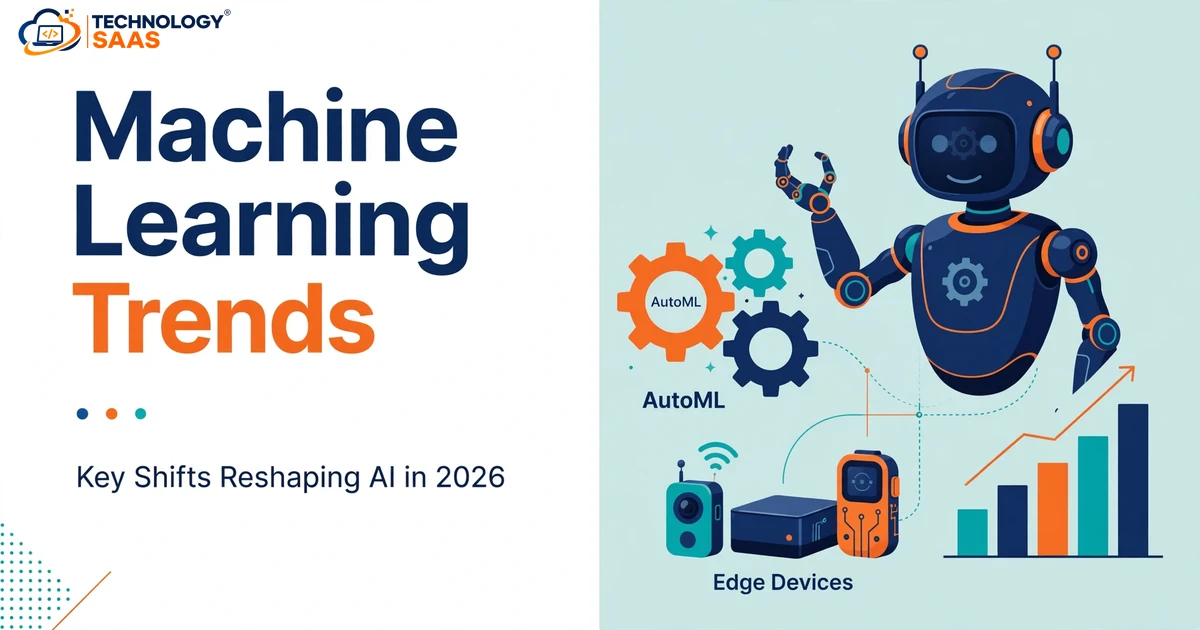
The ten trends below are the real 2026 developments. Each one covers what it is, why it matters, and what to do about it. The list follows the trends the top five ranking pages agree on, plus two they miss: LLMOps and decision intelligence.
1. Agentic AI: Systems That Plan and Act
Agentic AI is the move from tools that answer questions to systems that plan, decide, and take multi-step actions on their own. A chatbot suggests a reply. An agentic system checks stock, places an order, updates the customer, and logs the result. McKinsey’s State of AI survey (November 2025) reported that 23 percent of organizations were actively scaling AI agents, with another 39 percent experimenting. The risk rises with the autonomy, so start with one low-risk workflow, such as drafting replies for human approval.
2. AutoML: Machine Learning Without a Data Science Team
AutoML, or automated machine learning, automates the repetitive parts of building a model: preparing data, choosing a model type, tuning settings, and comparing results. It removes the biggest barrier, the need for deep technical skill, so small teams can test an idea in days instead of hiring a specialist first. It does not fix bad data or a vague goal: a model built on messy, unlabeled data looks fine in testing and fails once it is live. Start with a clean, small dataset and one clear question, such as which customers are likely to leave this month.
3. MLOps and LLMOps: Running Models Like Products
Many teams can build a model. Fewer can run it reliably. MLOps is the set of practices that keeps a model working after launch: versioning, monitoring, drift detection, retraining schedules, and safe deployment. LLMOps is the same idea for large language models, and it is the addition the top five ranking pages miss: prompt versioning, evaluation pipelines, cost tracking per request, and safety checks on model output. Invest in monitoring before scaling model use, not after.
4. Generative AI Embedded in Business Workflows
Generative AI has moved from novelty to core business infrastructure. It now writes first drafts, summarizes documents, generates code, and supports customer service inside daily workflows. McKinsey’s March 2025 survey found that 71 percent of organizations regularly use generative AI in at least one function, up from 65 percent in early 2024. Stanford’s AI Index 2025 recorded private investment in generative AI of 33.9 billion dollars in 2024, up 18.7 percent from 2023. PwC estimated in its 2017 report that AI could contribute up to 15.7 trillion dollars to the global economy by 2030. That value arrives only when a team redesigns the workflow, not when it adds a chatbot to the old one.
5. Real-Time Predictive Analytics: Decisions at the Speed of Data
Predictive analytics applies machine learning to historical data to forecast what is likely to happen next: fraud, demand, churn, or equipment failure. The 2026 shift is speed: businesses now expect the forecast while the data is still fresh, not in next week’s report. It is the most mature trend on the list, and its value is direct and easy to measure, which is why it is often the first machine learning project a business should fund. Decision intelligence, the step the ranking pages miss, connects a model’s output to a business decision and a KPI. A model that predicts well but changes nothing is a dashboard, not a decision.
6. Small Language Models: Big Capability in a Small Package
Small language models use far fewer parameters than the largest models, which lets them run on phones, laptops, and edge devices instead of in a distant data centre. They are cheaper to run, faster to respond, and easier to fine-tune for one specific task, such as classifying support tickets. For many business jobs, a small model that knows one domain well beats a large model that knows everything shallowly. The trade-off is breadth: a small model will not write a strategy document or reason across unfamiliar topics. Test a small model on the team’s three most repeated tasks before paying for a large one.
7. Edge AI: Intelligence Where the Data Is Created
Edge AI runs the model on the device itself, a sensor, a camera, a phone, or a factory machine, instead of sending data to a cloud server. The main draw is latency and privacy: a factory sensor flagging equipment failure cannot wait for a round trip to an API, and a hospital device may not be allowed to send patient data off site at all. Models running on a device need to be smaller and lighter, which is why small language models keep appearing alongside edge AI in 2026 coverage. Plan for constrained compute and simpler models, and keep the heavy work in the cloud.
8. Multimodal AI: More Inputs, More Usefulness
Multimodal AI combines text, images, audio, video, and structured data in one system, so it can understand a document, a photo, and a spoken question together. A support team can feed it a photo of a broken part plus a customer’s message and get a diagnosis. Start with one high-value workflow, such as document extraction plus classification, then scale from there. Multimodal systems are only as good as the data they are fed, so clean inputs come first, then the model.
9. Responsible AI, Explainability, and Governance
As machine learning moves into hiring, lending, healthcare, and other sensitive decisions, the question is no longer only what a model predicts, but whether its decisions can be explained, audited, and defended. Explainable AI gives a reason for a decision, not just a score. Governance sets who approves a model and what “safe enough” means. The law has caught up: the EU AI Act, Regulation (EU) 2024/1689, entered into force on 1 August 2024, its bans and AI literacy duties apply from 2 February 2025, and its rules for general-purpose AI models from 2 August 2025. Fines reach up to 35 million euros or 7 percent of worldwide annual turnover for the most serious breaches.
10. Privacy-First Data: Federated Learning and Synthetic Data
Two methods help teams train models when real data is scarce, sensitive, or stuck in separate places. Federated learning trains a model across distributed devices without centralizing the underlying data, so hospitals can collaborate without sharing patient records. Synthetic data mimics the statistical properties of real data without containing actual records. Both are still maturing, and neither is something a team plugs in without meaningful engineering effort. Synthetic data must be validated carefully so it does not introduce bias.
AutoML vs MLOps: What Is the Difference?
Readers who follow droven.io machine learning trends will meet AutoML and MLOps in almost every article, and the two are easy to confuse. They answer different questions, at different stages of a project.
| Question | AutoML | MLOps |
|---|---|---|
| What problem does it solve? | Building a model is slow and needs specialists | A deployed model drifts, breaks, or goes stale |
| Which stage? | Before launch: data prep, model choice, tuning | After launch: monitoring, retraining, deployment |
| Who uses it? | Small teams, non-technical builders, startups | Any team running models in production |
| What goes wrong without it? | Experiments take weeks, or never start | A model that was accurate silently gets worse |
| First step | One clean dataset and one clear question | Version control and a monitoring dashboard |
A team needs both, in order. AutoML gets the first model built. MLOps keeps it honest.
Small Language Models vs Large Language Models: Which One Should a Team Pick?
Small and large language models are not rivals. They are different tools for different jobs, and the wrong choice wastes money in both directions.
| Factor | Small language model | Large language model |
|---|---|---|
| Size | Far fewer parameters, fits on a device | Very large, runs in a data centre |
| Where it runs | Phone, laptop, edge device | Cloud API |
| Cost | Low, often a one-time setup | Pay per request, adds up fast |
| Privacy | Data can stay on the device | Data usually leaves the building |
| Best for | One repeated task, done well | Broad reasoning, unfamiliar topics |
| Weakness | Narrow, cannot generalize far | Expensive, slower, harder to audit |
If the task repeats daily inside one domain, test a small model first. If it changes every time, use a large model and watch the bill. Most teams end up using both.
How Can a Reader Use This Coverage Well?
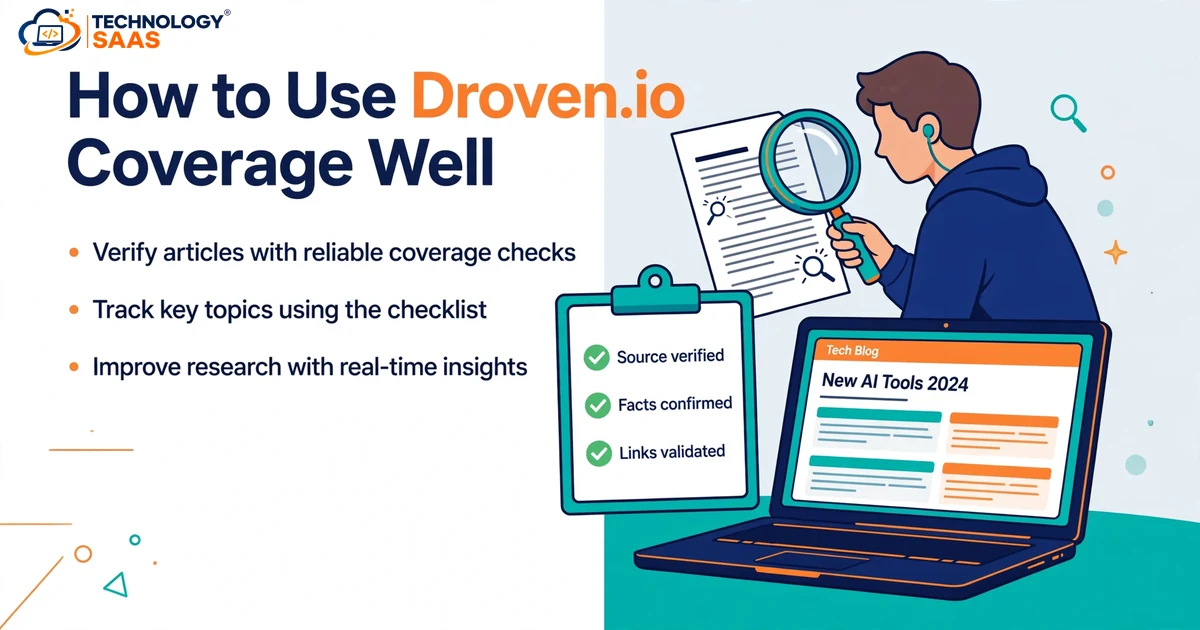
A reader who treats droven.io machine learning trends as a reading list, not a product catalogue, gets far more from it.
- Read the trend, then name the job. Write one sentence: “This trend would help us with X.” If none fits, skip the trend.
- Check the date on the article. A trend list from early 2025 may already be out of date.
- Follow one claim to its source. If an article quotes a market figure, find the named report. With no named report, treat the figure as a rumour.
- Pick one trend per month. One trend, one workflow, one month.
- Test on a small, real task. Use a week’s worth of real tickets, invoices, or messages, not a demo dataset.
- Measure before and after. Time the workflow today and again after a month. If the number did not move, the trend did not help.
- Keep a shortlist of real tools. Check a named tool’s pricing page, documentation, and two independent reviews before shortlisting it.
Reading takes an afternoon. Testing takes a month. Only the test produces evidence.
What Should a Reader Check Before Trusting Any Machine Learning Trend Claim?
Trend coverage is only useful if its claims survive a check. The same check works on droven.io machine learning trends pages and on any other trend list.
- Open the source’s own site first. For Droven.io, that step alone ends the product question.
- Look for the named report behind every figure. A figure with no named source is a guess with a decimal point.
- Check the date. A 2017 estimate, such as PwC’s 15.7 trillion dollar figure, is a long-range forecast, not a 2026 measurement.
- Search the loudest claim in quotation marks. If every result repeats the same wording, the reader is looking at copies, not confirmation. Ten pages repeating one description is one claim copied ten times.
- Ask who benefits if the claim is believed. A vendor benefits from a trend that needs its product. An editorial site benefits from a trend that needs reading.
- Ask for a test, not a promise. A real tool offers a trial or a small paid test. A trend article offers none of these, because it sells nothing.
Google Search Central’s helpful content guidance makes the same point: content should show first-hand experience and be written for people, not for search engines. A claim that passes at least five of the six steps is worth testing. A claim that fails the first two is worth ignoring.
Who Should Read Droven.io, and Who Should Not
Droven.io fits readers who want background before a decision: business owners, developers, students, and founders building knowledge before spending. It is not for a buyer who needs a supplier, a price, or a track record, and no figure from it belongs in a budget request. It is not for a researcher who needs a named author, a cited source, and a date on every claim. And it is not for a team that needs a model deployed this week: for that, the team needs a real tool, a real vendor, and a real pilot.
Frequently Asked Questions
What does “droven.io machine learning trends” mean?
It refers to the site’s plain-language explainers about agentic AI, AutoML, MLOps, edge AI, and responsible AI. It is a phrase about reading, not a product.
Is Droven.io a machine learning tool?
No. Droven.io is a free editorial tech blog. It does not build, sell, host, or deploy machine learning software. It publishes articles about machine learning, cloud, cybersecurity, and digital transformation.
What are the top machine learning trends for 2026?
The droven.io machine learning trends list covers agentic AI, AutoML, MLOps and LLMOps, generative AI in workflows, real-time predictive analytics, small language models, edge AI, multimodal AI, responsible AI and governance, and privacy-first data.
What is the difference between AutoML and MLOps?
AutoML automates building a model: data preparation, model selection, and tuning. MLOps manages that model after it is deployed: versioning, monitoring, drift detection, and retraining. AutoML answers “how do we build it fast”, while MLOps answers “how do we keep it working”.
Are small language models better than large ones?
Neither is better in general. Small models are cheaper, faster, more private, and better for one repeated task, while large models handle broad reasoning and unfamiliar topics. Most teams use both.
How often should a reader check machine learning trend coverage?
Weekly is enough. A short weekly scan of a trusted source, plus one trend tested per month, beats a daily flood of trend lists.
Is Droven.io free to read?
Yes, as far as reading goes. The site is free, it asks for no sign-up, and it takes no payment, so there is nothing to hand over. The risk comes later, when a business treats write-ups about Droven as proof of a company it can hire.
Conclusion
The phrase promises a product. The site delivers reading. Droven.io is a free editorial tech blog that explains machine learning in plain language. The trends themselves are real: agentic systems, automated model building, operational discipline, generative workflows, real-time prediction, smaller models, edge deployment, multimodal understanding, responsible governance, and privacy-first data.
Use droven.io machine learning trends as a starting point, not a finish line. Read the coverage, check each figure against its named source, pick one trend, and test it on one real workflow for a month.