
Introduction
A reader types “fintechzoom lucid stock” into Google and gets a wall of numbers: a live price near $2.96, price targets from $3 to $17, one analyst calling the stock a sell, another keeping a buy rating at $9, and headlines about a $1.75 billion Saudi loan, a production cut, and a cheaper midsize car coming in 2027. The numbers disagree, and none of them says what to do with them. That is the problem this article solves. It sorts the FintechZoom style coverage of Lucid into facts, analyst views, and open questions: the current price and what it is based on, the third quarter results and why they split opinion, the forces moving the stock in November, and the risks that could pull it further down. By the end, a reader can check Lucid stock in five minutes and know which numbers matter.
What FintechZoom Lucid Stock Means
FintechZoom is a finance news website that covers stocks, crypto, and markets with price pages, news, and forecasts. When readers search for fintechzoom lucid stock, they are usually looking for FintechZoom style coverage of Lucid: the current Lucid share price, recent news, and a forecast for where the stock may go next. The phrase itself is not a product or a ticker. It is a search habit, and it points at one company, Lucid Group, Inc., listed on the Nasdaq under the ticker LCID.
Lucid is an American maker of luxury electric vehicles, headquartered in Newark, California. Its best known products are the Lucid Air luxury sedan and the Lucid Gravity SUV, built at its AMP-1 factory in Casa Grande, Arizona. The company also sells its electric powertrain and battery technology, and it is building a second assembly plant in Saudi Arabia. Saudi Arabia’s Public Investment Fund is Lucid’s largest backer and lender, and it expanded the company’s loan facility by $1.75 billion in November 2026. Silvio Napoli is the chief executive, having taken the role in June 2026.
So when a FintechZoom article talks about Lucid stock, it is talking about a share in this business: a small luxury electric vehicle maker that sells a few thousand cars a quarter, loses money on every car it builds, and survives on the funding of its Saudi backer while it works toward a cheaper midsize car. That is why fintechzoom lucid stock searches keep growing: one phrase covers the price, the news, and the forecast in a single query. The stock price is simply what buyers and sellers agree a share is worth on a given day, and that price moves with earnings, guidance, product news, and the wider market.
Lucid Stock at a Glance
The table below gives the fintechzoom lucid stock snapshot as of the close on 13 November 2026. Prices move during the trading day, so these figures are a dated snapshot, not a live quote. The source for the price and market data is Finnhub market data, with analyst and earnings figures from the sources named in the table notes.
| Item | Figure, 13 November 2026 close |
|---|---|
| Exchange and ticker | Nasdaq: LCID |
| Price, close 13 Nov 2026 | $2.96 (Finnhub $2.955), down $0.30 (-9.22%) on the day |
| Open, high, low on 13 Nov | Open $3.25, high $3.25, low $2.94 |
| Previous close, 12 Nov 2026 | $3.255 |
| Market capitalisation | About $1.2 billion (TickerReport records $1.16 billion on 14 Nov 2026; MarketBeat records $1.28 billion; Finnhub stores $1.45 billion) |
| 52 week range | $2.37 to $14.26 (Finnhub candles; MarketBeat records $14.91 as the high) |
| Price to earnings ratio | Negative, the company is loss making (TickerReport records -0.22) |
| Beta | About 0.95 (Finnhub; TickerReport records 0.80) |
| Five session return | About -10.2 percent (from the $3.29 close on 6 Nov 2026) |
| One month return | About -15.6 percent (Finnhub) |
| Year to date return | About -72.0 percent (Finnhub; MarketBeat -72.1 percent) |
| Latest results | Q3 2026: adjusted loss of $2.30 per share on revenue of $350.3 million (9 Nov 2026) |
| Next earnings | 23 February 2027 (estimated, TrendSpider) |
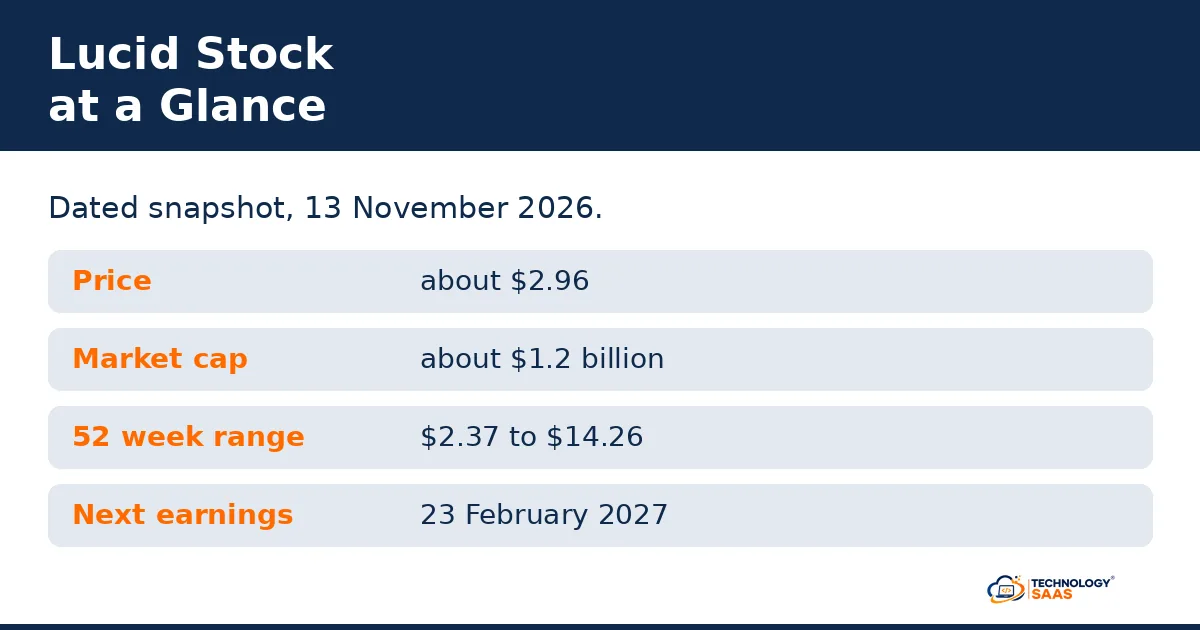
Three numbers in that table deserve a second look. First, the 52 week range. Lucid traded as low as $2.37 on 14 July 2026 and as high as $14.26 in the same twelve months, so the current price near $2.96 sits about 25 percent above its low and about 79 percent below its high. A stock that has lost four fifths of its value from its high is not the same kind of holding as a stock near its high, and any forecast has to be read with that fall in mind. Second, the market capitalisation near $1.2 billion. Tesla, the company covered in the previous TechnologySaaS article, is worth about $1.5 trillion, more than a thousand times as much. Lucid is a small company by stock market standards, which is one reason its share price moves so fast on small amounts of news. Third, the year to date return near minus 72 percent. Lucid started 2026 trading at $10.57, according to MarketBeat, and has lost almost three quarters of its value since. A reader who only looks at the $2.96 price misses that history, and the history is the context every price target sits inside.
The recent price action shows that volatility clearly. Lucid closed at $3.60 on Monday 9 November, the day it reported third quarter results. It rose 4.72 percent to $3.77 on Tuesday 10 November, slipped to $3.67 on Wednesday, fell 11.31 percent to $3.255 on Thursday 12 November, and then fell another 9.22 percent to $2.955 on Friday 13 November. The same stock that looked like it had survived earnings on Tuesday had lost about 18 percent of its value by Friday. That is why a single day’s move says so little about Lucid, and why the five minute routine at the end of this article checks the range and the trend rather than one close.
What the Third Quarter Results Actually Showed
Lucid reported third quarter 2026 results after the close on Monday 9 November 2026, and the numbers explain the analyst disagreement below. Revenue was $350.3 million, up 4.1 percent from $336.6 million a year earlier, but about $50 million below the roughly $396 million to $407 million that Wall Street had expected. The adjusted loss was $2.30 per share, wider than the $2.21 to $2.27 consensus. Deliveries were 3,806 vehicles, down 7 percent from a year earlier and down 4 percent from the second quarter. Production was 2,954 vehicles, deliberately cut from 4,774 in the second quarter.
The production cut was the most deliberate part of the quarter. Lucid removed a second shift at its AMP-1 factory in June 2026 to match output to near term demand and to turn inventory into cash. Deliveries were higher than production in the quarter, which means the company sold cars out of stock it already held. That is a planned inventory reduction under the operating reset launched by chief executive Silvio Napoli, who took the role in June 2026 and gave his first full earnings report with these results.
The rest of the quarter shows a company still losing heavily, but losing less quickly than before. Gross margin was negative 73.7 percent, against negative 99.1 percent a year earlier and negative 105.3 percent in the second quarter of 2026, after inventory write downs of $94.5 million. The adjusted EBITDA loss was $726 million, an improvement of nearly 20 percent from the second quarter. Free cash outflow was $1.04 billion, down 30 percent from the second quarter. Lucid says it has achieved about $800 million in savings so far this year and is on track with its full year cash flow improvement plan.
The funding picture is what kept the stock from falling further on the results. Saudi Arabia’s Public Investment Fund expanded Lucid’s delayed draw loan by $1.75 billion, lifting pro forma liquidity to $3.75 billion, from $2.00 billion at 30 September 2026. Lucid says that money funds operations and key investments into the fourth quarter of 2027, bridging the gap to the start of production for its midsize vehicle, planned for the second half of 2027. The reveal and production dates for that car are expected to be announced in the first quarter of 2027, along with a mid term plan.
Read together, the quarter says this: the company missed on sales and on earnings, cut production on purpose, burned a billion dollars of cash, and survived because its Saudi backer lent it more money. A reader who only sees the revenue miss misses the loan that followed it. A reader who only sees the loan misses the fact that deliveries fell and no guidance was given for the fourth quarter or the full year. Both halves matter, and the analysts below weight them differently.
What Analysts Expect From Lucid Stock
Analyst forecasts are the part of fintechzoom lucid stock coverage that readers click on most, and they are also the part most often misunderstood. A price target is one analyst’s opinion about where a stock could trade in twelve months. A consensus is the average of many such opinions. Neither is a promise, and the spread between the highest and lowest target says as much as the average does.
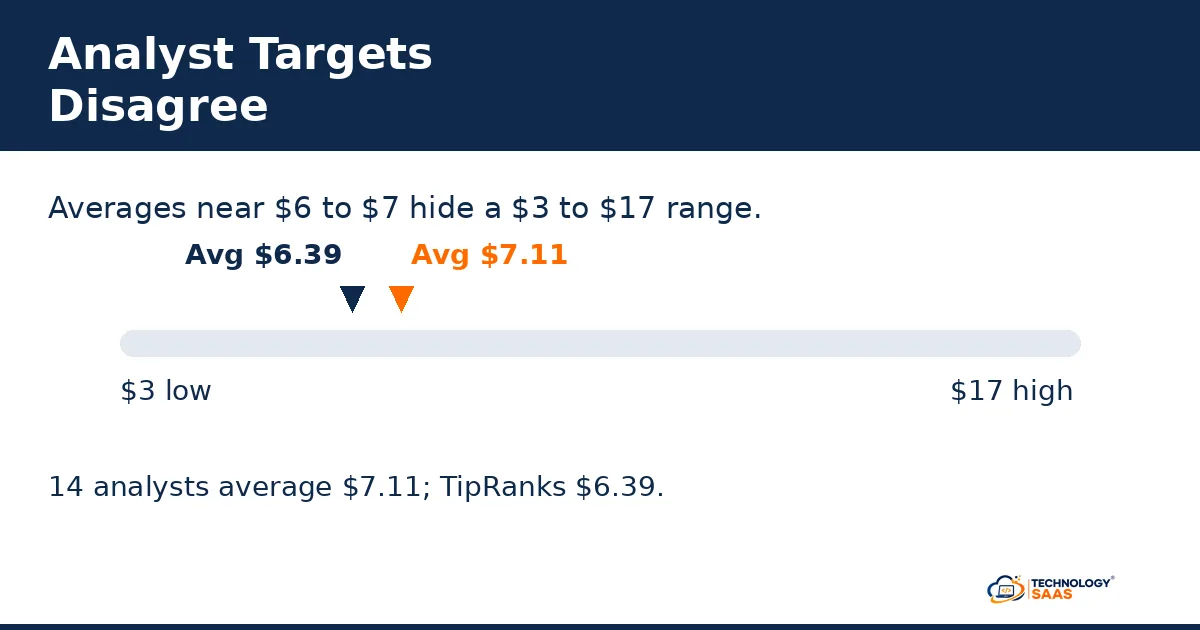
The published views on Lucid stock as of 13 November 2026 disagree by a very wide margin. MarketBeat records a consensus rating of Reduce and an average twelve month target of $7.11, about 141 percent above the current price near $2.96. That average comes from 14 analysts: one Buy, ten Hold, and three Sell. TipRanks records a lower average of $6.39 from 12 analysts, with a high forecast of $17.00 and a low forecast of $3.00, and a consensus of Hold. The two averages are close, but the range behind them runs from $3 to $17, which is a statement of uncertainty, not a target.
The individual ratings tell the story more clearly than the averages. After the third quarter results, Citigroup cut its target from $11 to $9 on 11 November but kept a Buy rating. TD Cowen cut its target from $7 to $4 on 10 November and kept a Hold rating. Robert W. Baird cut its target from $6 to $5 on 10 November with a Neutral rating. Cantor Fitzgerald cut its target from $8 to $6 on 10 November with a Neutral rating. Morgan Stanley had already cut its target from $5 to $3 on 15 October with an Underweight rating, and the Royal Bank of Canada cut its target from $7 to $4 on 12 October. Two analysts turned bearish after the results, according to Insider Monkey on 13 November. The highest target still standing is $17, held by Stifel with a Hold rating and by Mizuho, which cut from $21 to $17.
The oddity in these numbers is worth spelling out. The average target near $7 is more than double the current price, yet the consensus rating is Reduce, and the most recent rating changes are all cuts. That happens because the average still holds older, higher targets from before the stock fell, while the freshest opinions are the cuts. A reader who quotes the $7.11 average as if it were today’s view is reading old numbers. The newest numbers are the cuts to $3, $4, $5, $6, and $9, and they point the other way.
For the next quarter, TipRanks records an estimated loss of $2.31 per share, with a range of $2.96 to $2.02, and sales of about $439 million. The fourth quarter 2026 report is expected on 23 February 2027, according to TrendSpider. The stock trades below its 50 day moving average of $3.73 and well below its 200 day moving average of $6.53, according to TickerReport, which means the recent trend has been down on both measures.
What Is Driving Lucid in November 2026
Four stories explain why fintechzoom lucid stock coverage is so busy this month, and each one cuts both ways.
The first story is the earnings miss itself. Revenue of $350.3 million against expectations near $400 million, and a loss of $2.30 per share against expectations near $2.25, was a double miss. It was also the first full report under a new chief executive, which made it a test of his transformation plan. The market’s first answer was forgiving, and its second answer was not.
The second story is the Saudi loan. The Public Investment Fund’s $1.75 billion expansion of Lucid’s loan facility lifted pro forma liquidity to $3.75 billion and extended the stated funding runway into the fourth quarter of 2027. That is why the stock rose 4.72 percent on Tuesday 10 November, the day after the miss: the loan answered the question of whether the company could keep operating while it waits for its cheaper car. But a loan is not revenue, and it has to be repaid or converted. It buys time, not profit.
The third story is the selloff that followed. On Thursday 12 November the stock fell 11.31 percent to $3.255, and on Friday 13 November it fell another 9.22 percent to $2.955, as investors weighed the miss, the wave of price target cuts, and continued weakness across electric vehicle stocks. Two days wiped out the post earnings gain and more. The speed of the fall is a reminder that a stock near $3 with a small market value can move 10 percent in a day on no new company news at all.
The fourth story is the midsize car. Lucid’s plan is to start production of a cheaper midsize vehicle in the second half of 2027, with the reveal and production dates to be announced in the first quarter of 2027. That car is the whole investment case: the Air and the Gravity are luxury products that sell in the thousands, and only a cheaper car can take Lucid to the volumes that would make the factory pay. Until the reveal dates appear, the midsize car is a promise, and the market is pricing it as an uncertain one.
None of this is a buy case on its own. It is the business and the news behind the price targets, and it is what a reader should check before quoting any target.
The Risks Behind the Headlines
Every fintechzoom lucid stock forecast sits on top of the same risks, and the coverage is clear about them. Readers who skip this section will misunderstand the targets above.
Losses are the biggest risk. Gross margin was negative 73.7 percent in the third quarter, which means Lucid loses money on the cars it sells before it even pays for its factories and offices. Free cash outflow was $1.04 billion in a single quarter. At that pace, even $3.75 billion of liquidity lasts only a few quarters without more funding, which is why the loan extension mattered so much and why the next funding question is never far away.
Falling sales are the second risk. Deliveries fell 7 percent from a year earlier to 3,806 vehicles, and production was cut to 2,954. The company guided to 25,000 to 27,000 vehicles of production for 2026, but it built only 13,228 in the first nine months, so the full year figure is out of reach. A carmaker that sells fewer cars each quarter while cutting production is shrinking, not growing, whatever the plan says about next year.
Dependence on one backer is the third risk. The Public Investment Fund’s loan is the reason Lucid can fund operations into the fourth quarter of 2027. That support has been reliable so far, but it also means the company’s future rests on a single shareholder’s willingness to keep lending. A reader who treats the loan as ordinary revenue is mistaking a lifeline for a business.
Execution risk is the fourth risk. The midsize car, the Saudi plant in final commissioning, and the mid term plan due in early 2027 are all promises about the future. Each one could add real value, and each one could also slip, cost more than planned, or arrive into a weaker electric vehicle market. The production cut shows management is willing to shrink to survive, which is disciplined, but it also shows that the current product range cannot carry the company.
Volatility is the fifth risk. A stock that falls 11 percent one day and 9 percent the next, on a market value near $1.2 billion, can move faster than a reader can react. A reader who checks the price once a month will see a different stock each time, and a reader who trades on a single day’s move is guessing, not analysing.
A reader who holds these five risks next to the drivers above has a fair picture: a small luxury electric vehicle maker with falling sales, heavy losses, a generous backer, and one big future product that has not arrived yet. That picture is more useful than any single price target.
How to Read FintechZoom Coverage Without Being Misled
Fintechzoom lucid stock coverage is useful when it is read as reporting, not as advice. Four checks keep it honest.
First, check the date. A price target from October is not the same as a price target from today, and a forecast page that updates daily can mix old and new numbers. The figures in this article are dated 13 to 15 November 2026, and a reader should recheck the live price before acting on any of them.
Second, separate facts from forecasts. The current price, the last earnings, and the next earnings date are facts. A twelve month target, a loan headline, and a consensus rating are opinions and reports. When a page presents both in the same style, the reader has to do the separating.
Third, ask who is behind a number. An average of 14 analysts is a broader base than a single model, but when the average is $7.11 and the consensus rating is Reduce, the average is hiding the real story, which is that the freshest opinions are cuts. The wide range from $3 to $17 is itself information.
Fourth, look for the spread, not just the average. When one source says $6.39, another says $7.11, one firm says $3 and another says $17, the average hides the real story, which is that professionals disagree. A narrow spread means confidence. A wide spread means uncertainty, and uncertainty should mean caution.
How to Track Lucid Stock Yourself
A reader does not need to follow fintechzoom lucid stock every day. A five minute routine, done weekly, covers what matters.
- Check the price against the 52 week range, near $2.96 the stock sits about 25 percent above its $2.37 low and about 79 percent below its $14.26 high, so a move of a few cents is normal noise, not news.
- Check the next earnings date, 23 February 2027 for the fourth quarter, and read the actual release rather than the headline.
- Check the consensus target and the range, not just the average, and note whether the range is narrowing or widening, and whether the newest changes are cuts or raises.
- Check deliveries and production, because those are the two operating numbers that now carry the whole story, and compare them with the guidance.
- Check for funding and midsize news, because a loan update or a reveal date can move the stock faster than earnings.
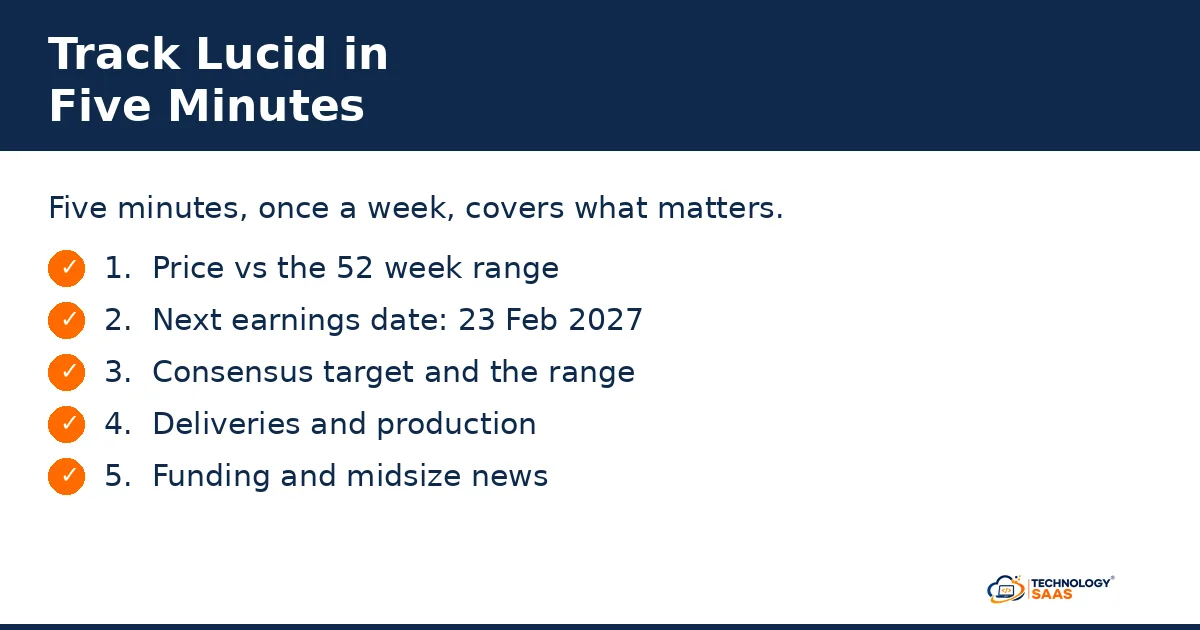
That routine fits in five minutes, and it keeps a reader ahead of most FintechZoom style headlines, because it checks the business behind the price rather than the price alone. Readers who want the wider context can also read the earlier TechnologySaaS article on FintechZoom Tesla stock, which uses the same five minute routine for Tesla, and the article on FintechZoom GM stock, which does the same for General Motors.
FAQs
What is fintechzoom lucid stock?
It is a search phrase for FintechZoom style coverage of Lucid stock, ticker LCID on the Nasdaq. Readers use it to find the current price, news, and forecasts for Lucid shares in one place.
What is the Lucid stock price today?
Lucid closed at $2.96 on 13 November 2026, down $0.30, or 9.22 percent, on the day. Prices move during the day, so any figure needs a live recheck.
What is the analyst price target for Lucid stock?
MarketBeat records an average twelve month target of $7.11 with a consensus rating of Reduce, while TipRanks records $6.39 with a consensus of Hold. Individual targets run from $3 to $17, and the most recent changes after the third quarter results were all cuts. Targets differ by source and change often.
Is Lucid stock a good buy?
No article can answer that for a reader, and this one does not try. The analyst consensus is mixed, the company loses money on every car, deliveries are falling, and the future rests on a midsize car that has not arrived yet. A reader should weigh those facts and, if needed, speak to a qualified financial adviser.
When does Lucid report earnings next?
The fourth quarter 2026 report is expected on 23 February 2027, with analysts estimating a loss of about $2.31 per share on sales of about $439 million, according to TipRanks.
What drove Lucid stock this week?
The stock closed at $3.60 on Monday 9 November after third quarter results, rose 4.72 percent to $3.77 on Tuesday after the Saudi loan expansion, slipped to $3.67 on Wednesday, then fell 11.31 percent on Thursday and 9.22 percent on Friday to $2.96, as price target cuts and electric vehicle weakness took over.
Final Words
Fintechzoom lucid stock is a useful search phrase because it gathers the whole Lucid story in one place: a price near $2.96, a 52 week range of $2.37 to $14.26, analyst targets averaging near $6 to $7 with a range from $3 to $17, a third quarter that missed on revenue and earnings while the Saudi backer lent $1.75 billion more, and a business driven by one future car while the current one shrinks. The numbers are worth knowing, and the disagreement between them is worth more than any single target. A reader who checks the date, separates facts from forecasts, watches the range rather than the average, and follows the five minute routine above will get more from FintechZoom style coverage than a reader who only reads the headline target. This article is information only, not investment advice, and every figure in it is dated 13 to 15 November 2026.