

Introduction
Search results for droven.io ai startup disagree with each other, and the disagreement costs readers real decisions. Some pages describe a careful check and conclude the site is a blog, not a startup. Others call it one of the fastest-growing AI startups of 2026 and 2027, predict its 2027 product plans, and never name a founder, a funding round, a product or a single customer. A reader who trusts the loud page could pitch, partner with or pay a company that does not exist in any public record. This guide shows the test, the evidence and the verdict, all dated 25 November 2026.
The Short Answer
No, there is no public proof that droven.io is an AI startup. Droven.io is a free editorial website that writes about artificial intelligence, automation, machine learning, cloud computing and cybersecurity. It has no named founder, no funding round, no company registration, no working AI product, no pricing page, no login and no customer list in any public source checked on 25 November 2026. The phrase droven.io ai startup is a search label, not a company fact. It describes what people type into Google, not what droven.io is.
That does not make the site useless. A free blog that explains AI tools and trends has real value for a reader who wants to learn. It only means the startup label should not be trusted. The rest of this guide shows the five tests, what droven.io actually publishes, and a ten-minute check the reader can repeat on any “AI startup”. Readers who want the full picture of the site itself should start with the TechnologySaaS guide to what is droven.io and the guide to about droven.io.
What Does “Droven.io AI Startup” Mean?
The phrase has two possible meanings, and only one of them is true. The first meaning is a claim: droven.io is an AI startup, a young company building AI software, with founders, funding and customers. The second meaning is a search query: people type “droven.io ai startup” because they saw the name next to AI content and want to know what kind of company it is. The evidence supports only the second meaning.
A startup, in the normal sense of the word, is a new company built around a product, with a team, some funding or revenue, and customers. A blog is a publication. Droven.io behaves like the second one. Its own footer describes it as a source of insights on AI, digital transformation and enterprise technology. That is the language of a publication, not a software vendor. Its articles explain tools such as ChatGPT, n8n, Make and Zapier. They do not sell a tool of their own. The guide to droven.io AI tools 2026 lists the 14 real tools the site writes about, with prices checked on 24 November 2026, and none of them is made by droven.io.
The confusion is easy to understand. In 2026, thousands of new sites call themselves AI startups, and a blog that writes about AI startups can look like one of them. The next section runs the test that separates the two, and it is the same test behind every droven.io ai startup verdict in this guide.
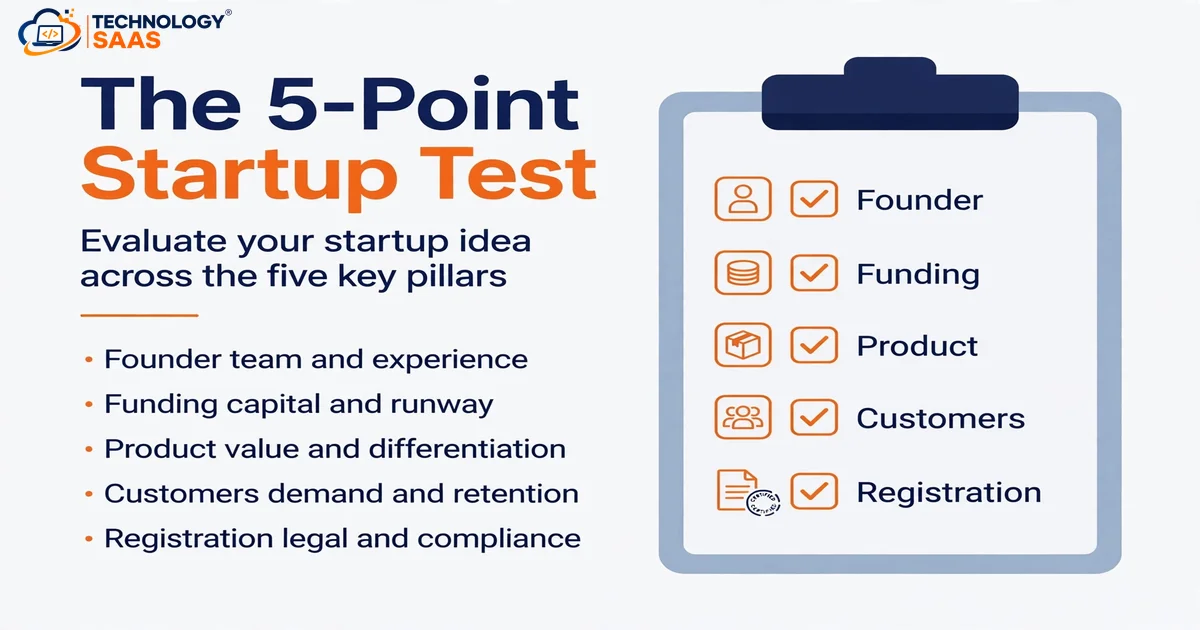
The 5-Point Startup Test: Is Droven.io a Startup?
A real AI startup passes five simple tests. Each one has a public answer. The table below applies the test to the droven.io ai startup question, using the checks made on 25 November 2026 and the checks other careful reviewers made before that date. A dash in the droven.io column means nothing was found, not that the search was skipped.
| Test | What a real AI startup shows | What droven.io shows (checked 25 Nov 2026) |
|---|---|---|
| 1. Named founder or team | Founders named on the site, with profiles, talks or interviews | None found. No founder, no team page, no named author on the site |
| 2. Funding round or investor | A round size, a date and an investor, on Crunchbase or in the press | None found. No round, no investor, no valuation in any public record |
| 3. Company registration or office | A registered company name, a country and an address | None found. No registration, no office, no legal entity named |
| 4. Working product or demo | A product page, a demo, a login or a pricing page | None found. No product, no demo, no login, no pricing page |
| 5. Customers or case studies | Named customers, logos, testimonials or case studies | None found. No customer name and no case study anywhere on the site |
Five tests, five blanks. That is not a close call. A startup that had raised money would say so. A startup with a product would show it. A startup with customers would name at least one. Droven.io shows none of these, because it is not built to sell software. It is built to publish articles.
The most careful competitor, TechInGot, reached the same result when it checked on 27 October 2026. Its list of what cannot be confirmed matches this table exactly: no named founder or leadership team, no funding round or investor, no company registration or office, no working AI product or demo or pricing page, no customer names or case studies, and no launch date for any software. Two independent checks, a month apart, found the same blanks.
One piece of evidence deserves a closer look, because it is the strongest thing the startup side can point to. Droven.io publishes a post called “Best AI Startups in USA”. In it, the site calls itself a “forward-thinking company”. But the same post shows no product screen, no price, no customer name, no founder and no checkable figure for droven.io itself, and it links to unrelated companies in the middle of the text. The post is dated April 2026, yet it talks about “2025”, and its description mentions hybrid cloud, which has nothing to do with the title. A self-description in a list post is a claim, not proof. The test above is the proof, and droven.io does not pass it.
The honest verdict is simple. Droven.io is a free AI and tech editorial site. The “AI startup” label is a search phrase, and repeating it as a fact would mislead the reader.

What Does Droven.io Actually Publish?
If droven.io is not a startup, the next question is what it is. The answer is a coverage map, and it is the real answer to droven.io ai startup from the other side: six topic areas, all free to read, and no product behind any of them.
| Topic area | What droven.io publishes | A TechnologySaaS guide on the same area |
|---|---|---|
| AI and generative AI explainers | What AI tools do, how chatbots and image tools work, beginner guides | droven.io AI tools 2026 |
| Business automation and RPA | Zapier, n8n, Make and GoHighLevel workflows, automation guides | droven.io AI tools 2026 |
| Machine learning trends | Healthcare, finance and marketing uses of machine learning | droven.io machine learning trends |
| Cloud computing | Cloud guides, migration and cost explainers | droven.io cloud computing guide |
| Cybersecurity | Security basics, threats and safe-use guides | what is droven.io |
| IT careers and certifications | Developer resources, career guides, certification explainers | about droven.io |
Three facts about this coverage matter for the reader. First, it is broad on purpose. A site that covers AI, automation, machine learning, cloud, security and careers in one place is chasing search traffic across many topics, not owning one niche. Blondish makes the same point: this broad spread is common for editorial AI sites. Second, it is free to read, with no login and no paywall. Third, it has no named authors and no team page, so the reader cannot check who wrote any single guide. That is normal for a content site and fatal for a startup claim. A startup hides nothing about its team. A blog can.
The practical takeaway is about use, not labels. Use droven.io the way a reader uses a free magazine: read an explainer, learn the basics, build a shortlist of real tools, then confirm every feature, price and privacy term on the tool’s own official site. The site is useful for learning. It is not a vendor, a partner or an investment.
Why Do So Many Pages Call It a Startup?
If the evidence is this clear, why does the “fastest-growing AI startup” version keep ranking for droven.io ai startup? Three reasons.
First, the label is profitable. “AI startup” is a high-interest phrase in 2026. A page that uses it in the title gets clicks from readers who want startup news, funding news and product launches. A page that says “this is a blog” gets fewer clicks. Some publishers choose the exciting label and skip the check.
Second, the check is rarely done. Most pages that call droven.io a startup never run the five tests above. They repeat each other. One page says “growing AI startup”, the next page quotes it, and after a few rounds the claim looks established. It is not. It is one untested claim copied many times.
Third, the hype version is specific enough to sound true. The TechFairHustle page, updated on 21 November 2026, says droven.io “went from a small blog to a full tech platform” and predicts 2027 plans: its own AI tools, video content, a community and startup interviews. None of that has a source. No founder announced it. No product page shows it. No funding supports it. The same page even concedes the truth in its own negatives section: droven.io is “mostly known for content and guides” and “does not yet offer many of its own AI tools”. A “full tech platform” that offers no tools of its own is not a platform. It is a blog.
The same warning applies to the “Drovenio” paid platform claims corrected in the Day 16 guide. Some ranking pages describe “Drovenio” as an enterprise platform with plans at $499 and $1,999 a month and a 40 percent productivity boost. No such product exists on droven.io, which has no pricing page, no login and no product. A price quoted for a product that does not exist is not a bargain. It is a fiction. Any reader who sees a droven.io price, plan or funding figure should ask for the official page it came from. There is none.
Do Not Mix It Up: Droven.io Is Not DRVEN, Drove, Drover or Drovo
Part of the confusion comes from the name itself. Four different companies share similar names, and a search result for one can easily be read as a result for another.
- DRVEN is a separate brand with its own product and site.
- Drove is a different company in a different market.
- Drover is a different company again, in car subscriptions.
- Drovo is another distinct name in the same space.
None of them is droven.io. Before trusting any funding profile, team page or product review, the reader should check the exact domain in the address bar. If the domain is not droven.io, the profile is not about droven.io. This one check removes a whole class of errors, and it takes five seconds.
The rule is simple: match the exact domain before trusting any claim. A Crunchbase profile, a LinkedIn page or a funding article that names a similar company proves nothing about droven.io. That check matters for droven.io ai startup because a funding profile for DRVEN or Drover is the easiest wrong answer to find.

How to Check Any “AI Startup” in 10 Minutes
The five-point test above works on any site that calls itself an AI startup, and the steps below turn it into a routine that answers droven.io ai startup for any site in ten minutes. Here is the check as a ten-minute routine, adapted from the verification steps TechInGot recommends, so the reader can repeat it without any special tools.
- Open the site and look for a product. A real startup has a product page, a demo, a login or a pricing page. If the site has only articles, it is a publication, not a startup.
- Look for a team page. Founders and teams are named on real startup sites, with photos and profiles. A site with no names has no team to check.
- Search Crunchbase for the exact company name. A funded startup has a profile with rounds, dates and investors. No profile, or a profile with no rounds, means no public funding.
- Search OpenCorporates for the exact company name. A registered company appears with a country and a registration date. No record means no public registration under that name.
- Check the domain age with ICANN Lookup. A domain registered weeks ago cannot belong to a company with years of history, and a domain with hidden ownership deserves extra care.
- Open the Wayback Machine and look at the site a year ago. A startup usually shows a product or a launch. A blog shows older articles on the same topics.
- Search for customers. Real startups name customers, show logos or publish case studies. A site with no customer anywhere has no customers to show.
- Compare three sources. If only one page makes the claim and the other two describe a blog, trust the two. One untested claim copied many times is still one claim.
If a site passes six or more of these eight checks, it is probably a real startup. If it passes none of them, as droven.io does, the label is wrong. The whole routine takes ten minutes, and it saves the reader from pitching, partnering with or paying a company that may not exist.
The AI Startup Boom in Numbers
The reason the startup label gets attached to any AI site is the size of the boom around it. The numbers are real, and they explain the temptation.
McKinsey’s State of AI survey, published in March 2025, found that 78 percent of organizations use AI in at least one business function, up from 55 percent in 2023, and that 71 percent regularly use generative AI in at least one function. Stanford’s AI Index Report 2025, published in April 2025, recorded private AI investment of 252.3 billion dollars in 2024, up 44.5 percent from 2023, with private investment in generative AI alone at 33.9 billion dollars. Real startups are raising real money, and real companies are buying real AI tools.
That boom is exactly why the check matters. When money moves this fast, a blog that writes about startups can be mistaken for a startup, and a made-up funding claim can travel far before anyone checks it. The figures above describe the market. They do not describe droven.io. No part of the 252.3 billion dollars is tied to droven.io in any public record, and this guide does not claim otherwise. For the tools droven.io actually writes about, with prices checked on 24 November 2026, see the guide to droven.io AI tools 2026.
Frequently Asked Questions
Is droven.io an AI startup?
No, not by any public evidence. Droven.io is a free editorial AI and tech blog. It has no named founder, no funding round, no company registration, no working AI product and no customers in any public source checked on 25 November 2026. The phrase droven.io ai startup is a search label, not a company fact.
Does droven.io sell AI tools?
No. Droven.io sells nothing. It writes about real AI tools such as ChatGPT, Claude, Midjourney, Zapier, n8n and Make, and it has no tool, price, plan or login of its own. Any page that lists a droven.io price is describing a product that does not exist.
Who owns droven.io?
No owner is named in any public source checked on 25 November 2026. The site shows no named founder, no team page and no company entity. Its terms and privacy pages carry a September 2025 date according to a third-party report (SoftCircles), which is not a date confirmed on the site itself. Do not trust any owner name unless it appears on droven.io itself.
Has droven.io raised funding?
No funding round has been found in any public record checked on 25 November 2026. There is no round size, no date and no investor on Crunchbase or in the press. A startup that had raised money would normally announce it. Droven.io has announced nothing.
Is droven.io free to use?
Yes. Droven.io is free to read, with no login, no account and no paywall. That is the normal shape of a content site, and it is one more reason the startup label does not fit. The full evidence is in the guide to about droven.io.
Why do so many articles call it a startup?
Because the label gets clicks, and because most pages repeat each other instead of running the check. One page called it a growing startup, others quoted it, and the claim spread. The pages that actually check, such as TechInGot on 27 October 2026, conclude it is a blog. The five-point test in this guide lets any reader check the droven.io ai startup question for themselves in ten minutes.
What should I use droven.io for?
Use it to learn. Read an explainer, understand a tool category, and build a shortlist. Then confirm every feature, price and privacy term on the tool’s own official site before paying. Start with the guide to what is droven.io, then the guide to droven.io machine learning trends.
Conclusion
That is the whole answer to droven.io ai startup: the phrase is a search label, not a company. Droven.io is a free AI and tech blog with no founder, no funding, no registration, no product and no customers in any public record checked on 25 November 2026. The five-point test shows five blanks, the coverage map shows six topic areas of free explainers, and the “fastest-growing startup” claims fall apart the moment a source is asked for.
The next step is a single one. The next time any site calls itself an AI startup, run the ten-minute check: look for a product, a team, a Crunchbase profile, a registration, a domain history and a customer. If the site passes, it is a startup. If it shows only articles, it is a blog, and it should be read as one. The Droven series on this site continues with the guide to Droven.io, the droven.io cloud computing guide, and the guide to droven.io AI tools 2026.
About the Author
This guide was written by the TechnologySaaS team, which publishes practical guides to AI, SaaS, and cloud tools. The team checks facts against each site’s own pages and public records on the day of publication and updates its guides when the facts change. Read more about the site on the About page or contact the team through the Contact page.
Published 25 November 2026. Last updated 25 November 2026.